Showing posts with label tolumnia genting orange. Show all posts

Thursday, August 16, 2012

Tolumnia Genting Orange bloomed continuously for 3 months

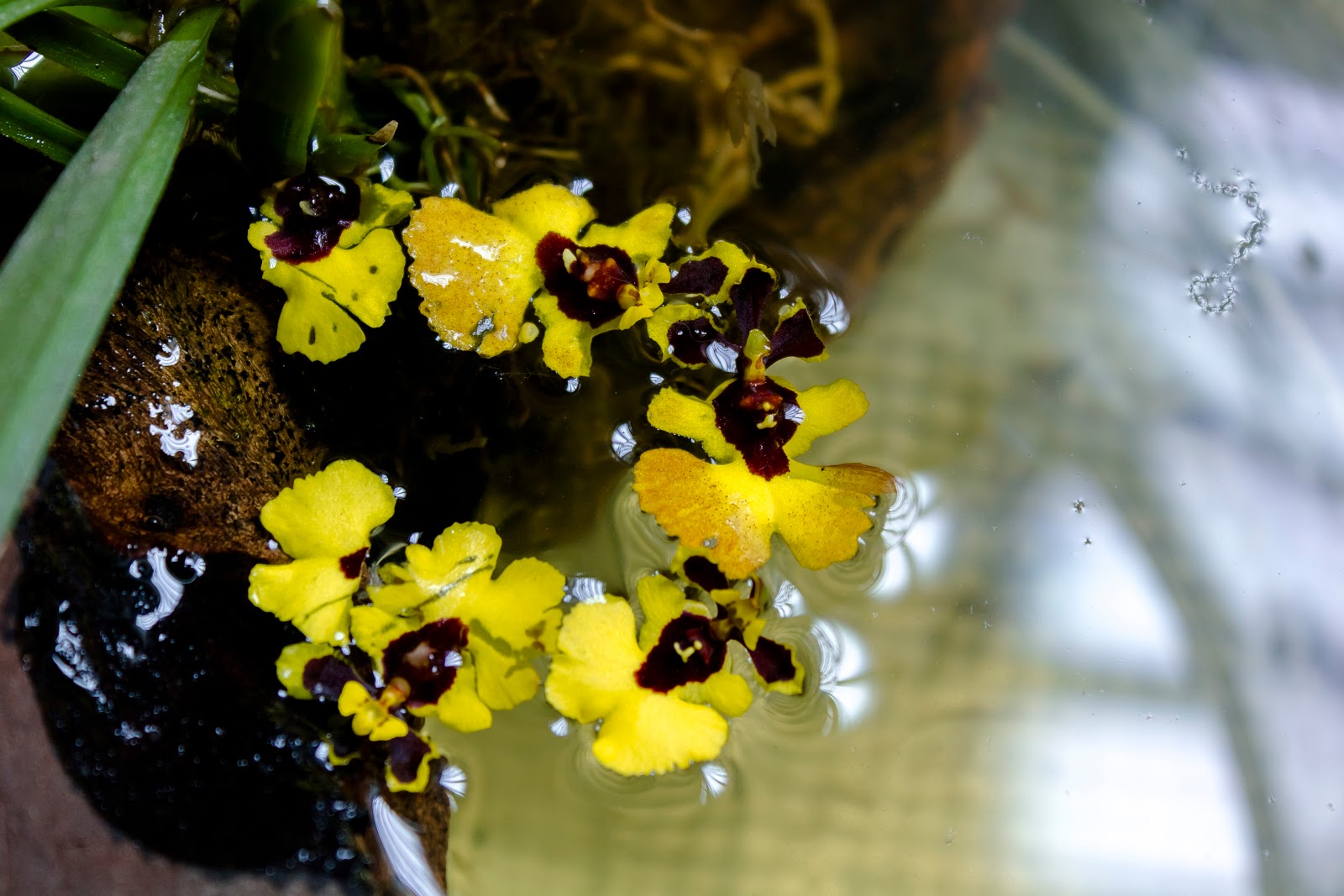
Decapitated orchid blooms

     I was really excited about posting today that the third round of blooms on my Tolumnia Genting Orange were finally open.  But the cat got to them before I did.  I set the orchid to soak in the watering basin, went to make my breakfast coffee, and came back to find all the flowers floating in the water.

     As it stand, my Tolumnia Genting Orange bloomed continuously since May 29--almost 3 months of blooming.  If these flowers had survived, they would have lasted at least a month more.

Saturday, August 4, 2012

Remounting Tolumnia Pink Panther

Tolumnia Pink Panther (left) and Tolumnia Genting Orange (right)

     I remounted my Tolumnia Pink Panther today, so that it could have its own mount. Having it co-mounted with the Tol. Genting Orange looked nice, but it made watering more awkward.  And I think both orchids are large enough to warrant separate mounts. 

     The transfer was very quick and fast.  I unpeeled the wire holding the orchid to its original mount, pulled off the plant+moss, and transferred it over to a new piece of aquarium bark.    The orchid had not been on its old mount long enough for the roots to start working their way into the bark yet, so remounting was a very simple procedure, that shouldn't have caused any root damage.

Saturday, June 30, 2012

Side spikes growing on Tolumnia Genting Orange

Start of new side-spikes towards the end of a bloom cycle


     One of the nice things I just learned about tolumnias, is that the blooming season is not necessarily over once the first round of flowers fades.  Although after two weeks in full bloom, most of the flowers quickly wilted, the orchid has started three new side spikes.  This means that there will likely be only a very brief interim (if any) between the last of the old flowers falling, and the first of the new flowers opening.


     Another interesting thing to note will be whether the subsequent blooms have as much variation in color and form as the first set.  I have not used any Superthrive on my orchids since coming home from Europe (adding only minimal fertilizer to the water), so I will be interested to see if removing the Superthrive will yield more uniform flowers.


Growing a new fan

     In addition to the activity on the spike, the tolumnia has started growing one new fan, and is also growing many new roots.

     All in all, I am thrilled with how this orchid is growing for me.


Sunday, June 17, 2012

Tolumnia Genting Orange variation in blooms

Tolumnia Genting Orange

     I posted some earlier photos of my Tolumnia Genting Orange, but this is a more detailed description of the flowers.  

     The miniature orchid bloomed with a foot-long flower spike, and 26 one-inch flowers. The blooms are very faintly scented.  The flowers open a solid yellow color (with the brown centers) and develop an orange hue around the skirt after about a week.  The flowers also develop brown spots in the back.  I found the flower spike very difficult to photographs because the blooms opened facing every which way.

     It's now been 3 weeks since the first flowers opened, and a few of the oldest blooms have wilted.  Most of the spike is still blooming profusely, though.

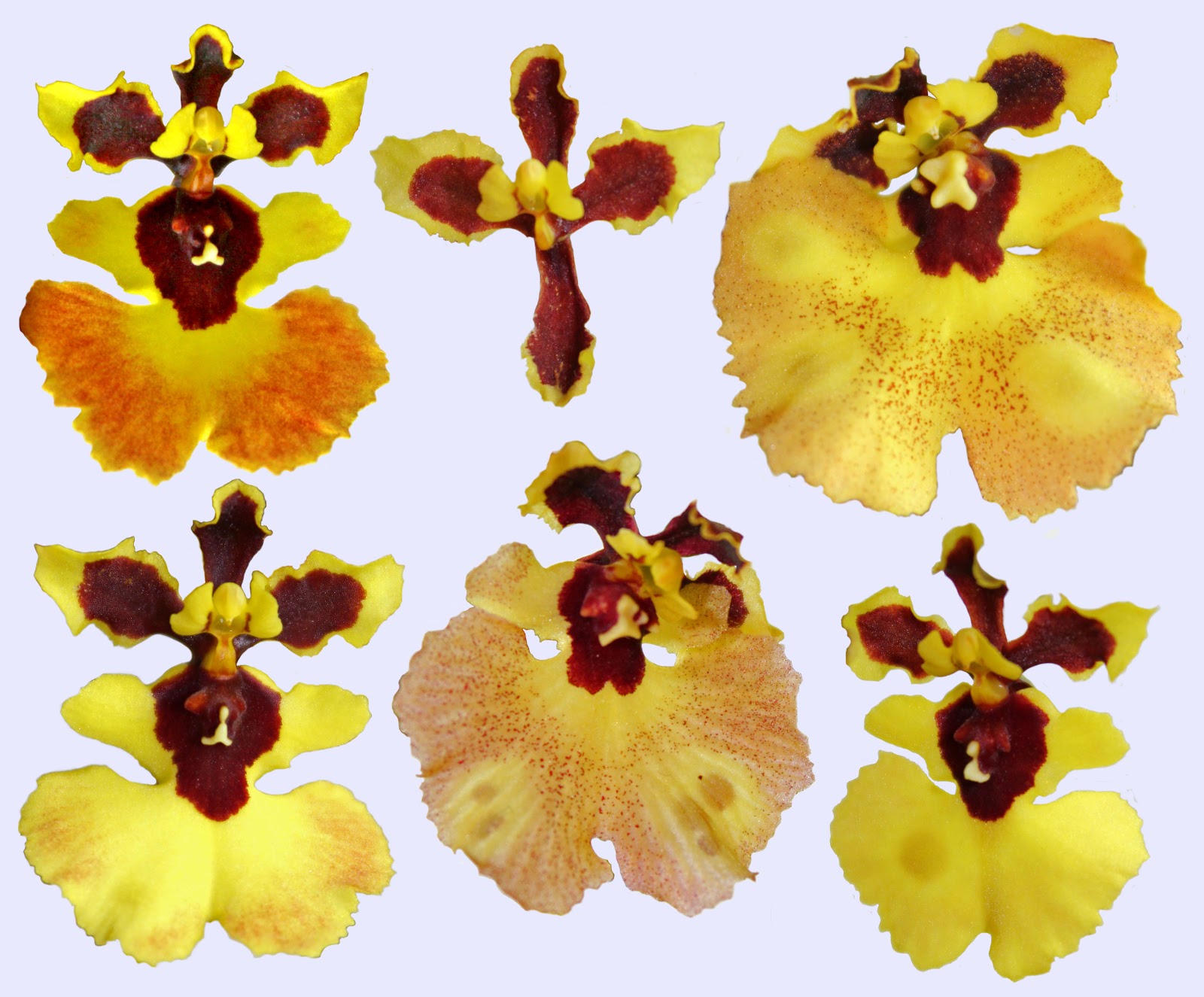
Variation in Tolumnia Genting Orange flower color and shape

    One interesting aspect of this blooming, is how different many of the flowers are from each other.  The picture above shows the variation of individual flowers on the spike.  The one on the top middle is clearly deformed (and there were a few blooms which looked like that), while the other flowers all look "normal". 
   
      I expect that the deformed flowers resulted from my recent Superthrive use, since others have reported too-high dosage leading flower aberrations.  I had only been using 1 drop into over a gallon of water, but since both this tolumnia, and my cattlianthe jewel box have recently produce some misformed flowers, I am concluding that even that tiny dosage was too high.  For now, I'm watering my orchids with pure water, and I will be diluting the superthrive much more in the future (most likely, 1 drop into a cup of water, and then a tablespoon of that water into a gallon of the final solution)

     However, even if the Superthrive explains the odd flowers, I think that the rest of the variation may be natural to this hybrid--which is really cool!  The pictures I found online tend to show only one type of flower per spike, but there is a lot of variation among the different photos:

Photo from Orchids by Hausermann (vendor)


Photo from Oak Hill Gardens (vendor)


    Judging by the difference among these pictures, it seems like most of my flowers fall within the common variation for this hybrid.


Thursday, June 14, 2012

Assessing the damage: coming home after two weeks away

The orchids were somewhat rearranged when I came back

     I left my orchids in the care of my bf during the two weeks that I was away, with the instruction to water all the mounted orchids every other day, and the potted ones whenever the wooden skewers tried out.  On my return, I found that most of my orchids were happy, a few had thrived, and only one suffered drastic damage.

     The first thing I noticed when I got home was that my orchids were all in different places than where I had left them. Most of this was not a problem, but the wilsonara at the top shelf had its leaves directly up against the lamp, which resulted in some lamp burn.

Sunburn damage on oncidium leaf

    A number of my oncidium and cymbidium plants lost a leaf or two over the last few weeks, but are otherwise fine.  In fact, the only 'casualty' from my two weeks away was my dendrobium victoria reginae.  It lost the one leaf it had, and the new cane growth dried up and died.  It roots are fine, and the canes aren't dehydrated, but I don't know if this particular den will successfully recover.  I ordered a replacement plant for in case it doesn't.

Wrinkling on psychopsis leaf shows dehydration

     The psychopsis looked very dehydrated.  I think in part, it's because I told bf to water it every other day (for simplicity of instructions and to avoid risk of overwatering) and in this case that wasn't often enough.  However, when I checked it's roots, I found that they were all hollow.  This would be no fault of bf's care, but rather the consequence of this plants poor health from the very beginning.  It's spike is still growing, but I don't know whether to expect it to bloom, or if it will survive or not.  In any case, I ordered another psychopsis as a travel companion for the new den victoria reginae.

Cattlianthe Jewel Box 'Scheherazade' flowers going out of bloom

     My cattlianthe flowers were already wilted looking by the time I got home.  They were also far less red than the earlier photos suggested.  Since the orchid was already getting the maximal amount of light it could handle, it must be the temperature which adulterated the blooms' color.  There is a third flower forming on the spike, and I moved the orchid to a windowsill, in hopes that the cooler air would help it develop a deeper red.  I'm not sure how successful my attempt will be however, since the weather is only getting warmer, and the flower bud is already pretty well developed.

New cattlianthe pseudobulb

     The new pseudobulb has nearly tripled in size over the last two weeks. Here is how the growth looked just two weeks ago.

Tolumnia Genting Orange

     Fortunately, my Tolumnia Genting Orange is in full bloom and going strong.  The flowers opened facing every which way, making the blooms hard to photograph.  I'll do a more detailed post on the orchid later.

New roots on Phal Memoria Audrey Meldman 'Mendenhall'

     My phals seemed to thrive under my bf's care, producing tremendous root growth.  For the rest of the orchids that I didn't mention--there were no notable changes.  They had neither grown nor suffered in my two weeks' absence.

     The bottom line seems to be that phals really are good beginner orchids, as they seemed to be the happiest under my bf's care.  My paphs probably come in as a close second, since none showed any signs of stress when I came back.  And finally, the only one of my orchids that really deteriorated, was one that was sickly to begin with.

Saturday, June 9, 2012

Tolumnia Genting Orange now in full bloom

Tolumnia Genting Orange: June 4

     Here is a series of photographs showing the maturation of the Tolumnia Genting Orange buds. The spike was very small when I received the plant in April, no more than 2 weeks old.  The first flowers opened on May 29, setting the spike maturation time at about 9 weeks.  Since I've not yet had the opportunity to see these flower in person, I'll save the descriptions until when I get back home.  It does seem as if the flowers open yellow, and acquire an orange hue as they age.  In the meantime, here is a series of photos depicting the growth of the flower spike.

April 3

May 19

May 26

May 28

May 30

May 31

June 3

June 4

Tuesday, April 3, 2012

Three new orchids

A new batch of orchids arrived in the mail

     The orchid show peaked my temptation to once again go orchid shopping.  I made myself wait a couple of  weeks, but when I saw a few of these plants go on sale, I ordered yet another batch of orchids for my collection.  On the left is an in-spike Psychopsis Mariposa 'Mountain.'  Meanwhile, on the right are two more tolumnias: Pink Panther and Genting Orange.  

     I intended to grow the tolumnias mounted, and the psychopsis had dead-looking roots poking out from the bottom of the pot.  Consequently the first thing I did after taking this picture was soak the plants in water to loosen the roots for re-potting.

Psychopsis root health: soon to be dead

     Frankly, the state of the psychopsis roots was disappointing.  A number of the longest roots had grown right out of the pot, and I unfortunately had to cause some damage when pulling the plant out.  Meanwhile, that soggy brown-looking thing in the middle of the picture (right at the base of the leaves) looks like ancient sphagnum moss.  

     I know psychopsis don't like being re-potted, but I am glad I did change the media immediately.  The media was very old, and none of the roots looked very healthy.  I trimmed back some of the mushy dead ones, and potted the orchid in a clear plastic pot with loosely packed fresh media.

Growing psychopsis spike

     The orchid did sell 'in spike' at a very attractive discount, so I  am hoping that it will be able to grow new roots and quickly establish itself in the new media.  If not, I will nurse it until it recovers.  Fortunately, my two oncidiums looked far worse and survived, and I expect to be able to save this orchid regardless of what happens in the next few months. 

Tolumnia Pink Panther

     Next I re-potted the two tolumnias.  Tolumnia Pink Panther had the healthiest roots of the bunch.  The root ball was about as big as the leaves themselves, and most of the roots were a healthy white/green color.  To me this looked like an orchid ready for re-potting-- but not over-ready.

Tolumnia Genting Orange

     Although it was in a smaller pot, Tolumnia Genting Orange had actually longer leaves than the Pink Panther (and slightly disappointingly, both were larger than my original Tolumnia Red Berry).  Here, the orchid looks like it should have been re-potted a season ago.  The healthy thicker roots were growing outside the pot.  Meanwhile the mass of roots within the pot is a lackluster tan, and of dubious health.  

     However, I am now realizing that both these plants have far healthier roots than the Tolumnia Red Berry which I bought at the NYBG orchid show. Although that orchid hasn't lost any leaves yet, I am rather concerned about whether it now has any healthy roots at all.

Tolumnia growing spike

     As a pleasant surprise I noticed that the Tolumnia Genting Orange was in spike as well (unlike the psychopsis, the plant was not listed as 'in-spike' on the online catalog).  This means that if I get the care conditions right, I may have new orchids coming in to bloom when my Wilsonara Pacific Perspective finishes flowering.

Two orchids, one mount

     I mounted both tolumnias on a log of 'aquarium decoration wood,' using some living moss and craft wire. The orientation of the top plant is not quite perfect (I would have liked it more vertical) but I figure the leaves will adjust over time. 

     With tolumnias I feel that the pots are so tiny, that I'd have to be watering them frequently anyway (my biggest concern with mounting orchids has been the necessity for daily watering).  At least with the mounts, I'm less likely to rot the roots by accident.  Meanwhile, since I can hang the mounts off the side of the shelf, I'm not taking away space from my other orchids. I love these cheery little orchids, and hope that I won't have casualties in my process of learning to grow them.