Tuesday, October 30, 2012

Repotting Paph noid

Noid Paphiopedilum

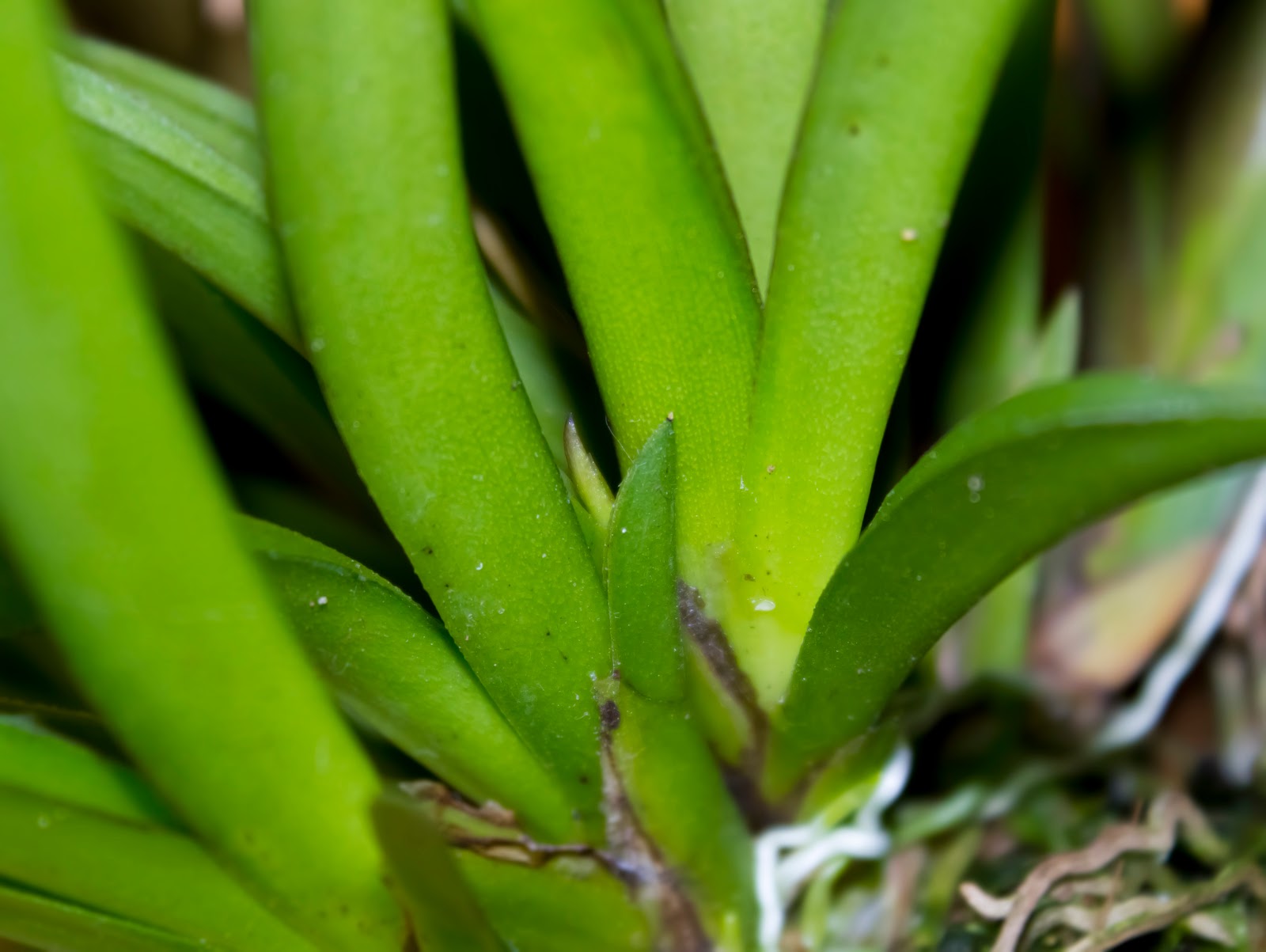
     I'm not sure what to do with my noid paph.  Last year's new growth keeps growing ever taller, and ever farther out from the media.  The stem on the growth keeps producing little root nubs which fail to grow.  Meanwhile, it keeps producing more leaves, making the whole thing ever taller and more unstable.

     My biggest worry is that if this year's newest growth appears high up on this stem, then there will be no way to bring its roots anywhere near the potting media.  

Paphiopedilum roots

     Although it hasn't been a year since the last repotting, I was a little concerned about the media taking a long time to dry between waterings.  Fortunately, all the roots were healthy.  They were also completely unchanged from last January.  I don't know what it would take to get this orchid to grow new roots into the media.


      I cleaned out the pot with a lysol wipe and a good wash, added fresh media, and put the paph back in, much as it was before.  The orchid shed one of its bottom leaves during the process (it had been only losely attached), but there is yet another new leaf growing from the crown.  To try and help promote at least a few more roots to grow from the stem, wrapped some sphagnum moss around the base, which I'll try to keep evenly moist.    

Sunday, October 28, 2012

Supplementing Paphiopedilum sanderianum with calcium

Paphiopedilum sanderianum (not yet blooming sized)

     Paph sanderianum is a calcicolous species; the term refers to plants which thrive in soil that is rich in lime.  In nature, Paph sanderianum orchids are found growing on limestone cliffs in Borneo.  Limestone is composed of different crystal forms of calcium carbonate.  In practical terms, this means that Paph sanderianum can benefit from calcium supplementation when grown at home.  

     Since the media I use for my paphs  does not contain any calcium, and New York City tap water contains rather low levels of soluble calcium, I wanted to try adding some calcium supplements. However, finding clear directions on how to do this proved difficult.  There is plenty of references to some paphs benefitting from extra calcium, and the most common method of supplementation I could find involved adding crushed limestone or oyster shell directly to the potting media.

Using crushed egg shells to supplement calcium for paphiopedilum

     Now I don't have any access to limestone or oystershells on hand, but I did have leftover egg shells, which are 95-97% Calcium carbonate crystals.  Although CaCO3 has very low solubility in water under non-acidic conditions, a little can go a long way.  

     I boiled the empty egg shells to get rid of all remaining egg whites, and peeled off the membranes covering the inside of the shells.  I then used a coffee grinder to crush the egg shells into small pieces, which I could sprinkle on top of my paph's potting media.  

     Unfortunately, I can't think of any way to make this more scientific.  I can't readily measure soluble calcium levels before or after supplementation, and with one plant, I can't attribute any changes in growth as a benefit from adding egg shells.  In addition, while writing this post, I remembered that my Paph Sanderianum had rocks in it's old media, which I had saved and mixed into fresh media when I repotted the orchid back in April.  It is very possible that those rocks are limestone gravel. To avoid accidentally overloading on the calcium, I don't plan to do this more than twice a year at most.

     In unrelated news, the Paph sanderianum is growing a new leaf.  It also has a mysterious bulge at its base which may be either a new root or a new growth, either of which would be really great news.


Friday, October 26, 2012

Remounting Tolumnia Red Berry

Tolumnia Red Berry

     Tolumnia Red Berry was my very first orchid mount.  I used a piece of driftwood that had been sold as 'aquarium decor'.  In 7 months since, the mount has started significantly decomposing.  

Closeup of decomposing mount

     The wood is now covered in algae and fungal growths.  It even grew an actualy mushroom from the bottom! (I wish I had thought to snap a picture of that before I snapped it off).  My other mounts are from a different, harder wood, and don't have anything more than a small amount of algae covering them.  Since I had an unused mount from when my now dead Den. victoriae-reginae, I decided to transfer my Tolumnia Red Berry over before its root growth made remounting more difficult.

New growth on Tolumnia Red Berry

     Peeling the orchid from its old pot was still quite easy; the new roots had not yet worked their way into the wood.  In the process, I discovered a new growth that was hiding at the back of the plant.

Freshly remounted Tolumnia

     The Tolumnia is now growing on a grapewood mount, which should hopefully fare better.  It's not as ascetically pleasing as the old mount, but the new mount is more space efficient, since I can hang it off the side of the shelves.

Wednesday, October 24, 2012

Paph Adam Hausermann x Duncan York seedlings: one thrives while the other falters

Paph (Adam Hausermann 'York' x Duncan York 'Good Show')

     When I purchased this paph cross in July, I was happy to discover that I had two separate seedlings in my pot, one slightly larger than the other.  In the 4 months since, the larger seedling has thrived, while the smaller struggles for survival. 

     Both seedlings shed one leaf each.  However the larger plant has since grown one new leaf, and is now growing another.  The smaller seedling is still struggling to push out the one new leaf it was working on when I first received it.

Paph seedling lost its roots, new root tip showing

     The reason for the disparate growth success lies in the roots.  The larger plant had two roots to begin with (while the smaller one had 1) and it grew two more roots over the last few months.  

     The smaller seedling, on the other hand, lost the one root it had.  My best guess is that the root died after snapping near the orchid's base soon after I first repotted it.  Both orchids were quite shaky in their pots due to their relative lack of root mass, and while adding supports helped stabilize both of them, I think I added them too late to help seedling #2.

     The rootless seedling does have one new root budding from its base however, so it still has a chance to survive.  I repotted it more securely back into its original pot.  The orchid will probably lose the lowest of its leaves before the new root can grow enough to support the plant.  Hopefully the other two leaves will hang on long enough for the root system to recover.

Tuesday, October 23, 2012

Second new growth on Cattlianthe Jewel Box

Cattlianthe Jewel Box 'Scheherezade'

     In addition to the nearly mature pseudobulb, and the new growth I recorded one month ago, there is a third pseudobulb that is just starting out.

First sign of new pseudobulb on cattleya

     In other less welcome news, I cut off one of the leaves, because it developed some suspicious spotting at the leaf's base.  Whatever it was, it didn't look like light damage or physical damage, and I didn't want to risk it spreading further.

Suspicious leaf damage

     None of the other leaves have similar damage, and I'll be checking regularly to make sure they stay clean.  Since I don't want to keep using the same fungicide at the risk of breeding resistant fungal strains, I ordered some physan.  This way, if I want treat a plant, I won't be using the same kind of chemical on it over and over again.

     I should probably also wipe down and disinfect my growing area.  I'm not sure when I'll get around to that though.


Sunday, October 21, 2012

First sign of flower spike on Dtps. Jungo City

Phalaenopsis spike, week 1

     The recent cooling of the temperatures must have sent "time to bloom" signals to my orchids.  In addition to Cattleya Cernua and Tolumnia Pink Panther, my Dtps. Jungo City is preparing to flower.

      This is another orchid flower spike that I managed to spot in its earliest stages. This little protrusion at the orchid's base is the start of a spike.  Two early signs differentiate it from a root: it's purple in color when every other root on this orchid emerged with a pale yellow-green tip.  And second, it's segmented.  This is really hard to see in the picture above, but became more apparent in the few days afterwards.
    
     This picture was taken on October 15.  I don't know how long the spike will take to reach maturity.  

Saturday, October 20, 2012

First sign of flower spike on Tolumnia Pink Panther

First glimpse of tolumnia flower spike (middle of picture)

     It's finally happening!  My Tolumnia Pink Panther, with its 14 mature growths and 4 new ones, is preparing to flower.  The flower spike emerges from one of the new growths from last May.  This picture is from the first day I noticed the spike (oct 18), when it was barely a quarter inch long.  However, in the two days since, it has already more than doubled in size.  

     The spike on Tolumnia Genting Orange was only a couple inches longer than this when I first purchased that orchid.  That spike took 9 weeks to mature.  At that rate, I expect Tolumnia Pink Panther to be in bloom by January.  

     Since the Tolumnia is quite large, I am also on the lookout for more spikes.  Either way, I have high expectations for these flowers... so long as I manage to keep them safe from the cat.