Sunday, September 9, 2012

Another bulb rots on Oncostele Pacific Perspective

Rotten pseudobulb on oncidium (right)

     My Oncostele Pacific Perspective lost another pseudobulb yesterday.  Although it still had green leaves attached, the bulb had turned mushy and had to be excised. This is the second pseudobulb to rot since it rotted its last one in May.  I am not sure what's causing this rot.  Generally orchids rot when there is too much moisture that is not drying out.  But if anything, I haven't been watering enough; the leaves on the newest growths are wrinkled from dehydration.  

     My guess would be that these problems arise from the orchid not having enough roots.  With its many old pseudobulbs, the orchid would not fit into any pot small enough to be appropriate for its root size.  As a result, the media would be both too dry near the top where many of the new roots were growing, and permanently soggy elsewhere, leading to bulb rot.

Oncostele Pacific Perspective

     Once again diminished, the oncidium is now in a 4 inch clear plastic pot, with loosely packed oncidium potting media.  There is a good amount of new root growth, which will hopefully support the two new growths as they mature.


Monday, September 3, 2012

Re-mounting Sophronitis Cernua

Dead sphagnum moss on a Sophronitis cernua mount

     When I was first mounting the Sophronitis cernua back in May, I used some live sphagnum moss to pack around the roots for added humidity.  However, sphagnum moss needed constant humidity to survive, and soon turned into dead mush (picture above).  For all my other orchids, I've been using moss gathered from my parents' backyard in Michigan, to much greater success.  This kind of moss is hardier, and can better survive drying out.  As I had some of the hardy moss left-over from my dead den victoria-reginae's mount, I decided to transfer some of it over and remount the soph cernua.

Sophronitis cernua remounted with fresh live moss

     The remounting process went pretty smoothly.  The clam shells I used as mounts are generally too smooth for the orchid's roots to attach to, so I had no difficulty swapping out old moss for new and reattaching the orchids to the shell. The two shell halves did fall apart from each other, so now the two cernuas are each separately mounted.

     The orchids themselves are growing well, albeit slowly.  Each plant has one new growth, as well as multiple new roots.  If my growing conditions are right, then I can expect some flowers after the new growths mature.

     I also recently noticed that the orchid's leaves lost their purple edging. Interpreting that as a sign that it needs more light, I moved the orchid another 4-5 inches closer to the light source.

Wednesday, August 29, 2012

Noid phal slows down, shows sign of dehydration

Noid phal

     I haven't posted much recently, because not much has happened recently.  Most of my orchids are currently growing new roots and leaves.  

     My smaller noid, on the other hand, seems to have gone into a rather pronounced rest period.  Its water consumption has declined (as seen by the time it takes for the media to dry out), but at the same time many of its oldest leaves are wrinkling and preparing to shed. It still has a new leaf growing, but the rate of growth is significantly slower than it was for the previous leaf.  I'm trying to navigate a rather confusing line between under- and over-watering.

Moss on an former orchid mount

     In fact the greatest amount of activity I've had has been from my moss, which has produced a fresh layer of new growth.  It looks bright green and fluffy.  At some time in the future I may use this mount for one of my orchids.

Moss looks pretty cool from up close


Monday, August 20, 2012

Name change: Wilsonara Pacific Perspective = Oncostele Pacific Perspective

Oncostele (Wilsonara) Pacific Perspective

     I was searching around on the International Orchid Register today, when I noticed that my oncidium intergenic has been reclassified into a new genus.  My wilsonara is now officially an oncostele. The change doesn't really mean much to me, but I generally try to stick with the most recent official classifications of my hybrids.

     I had the oncidium growing on a sunny bathroom windowsill over the summer, and the bright light resulted in quite a bit of leaf damage on this oncidium.  I'm switching this orchid's placement with my cymbidium, which should be better able to to handle the hours of direct sunlight on the windowsill.  The oncostele is going to my orchid shelves to grow under the lights, and I'm putting the Cym. (Gordon Gibbs x Billion Dollar Baby) on the windowsill instead.

Thursday, August 16, 2012

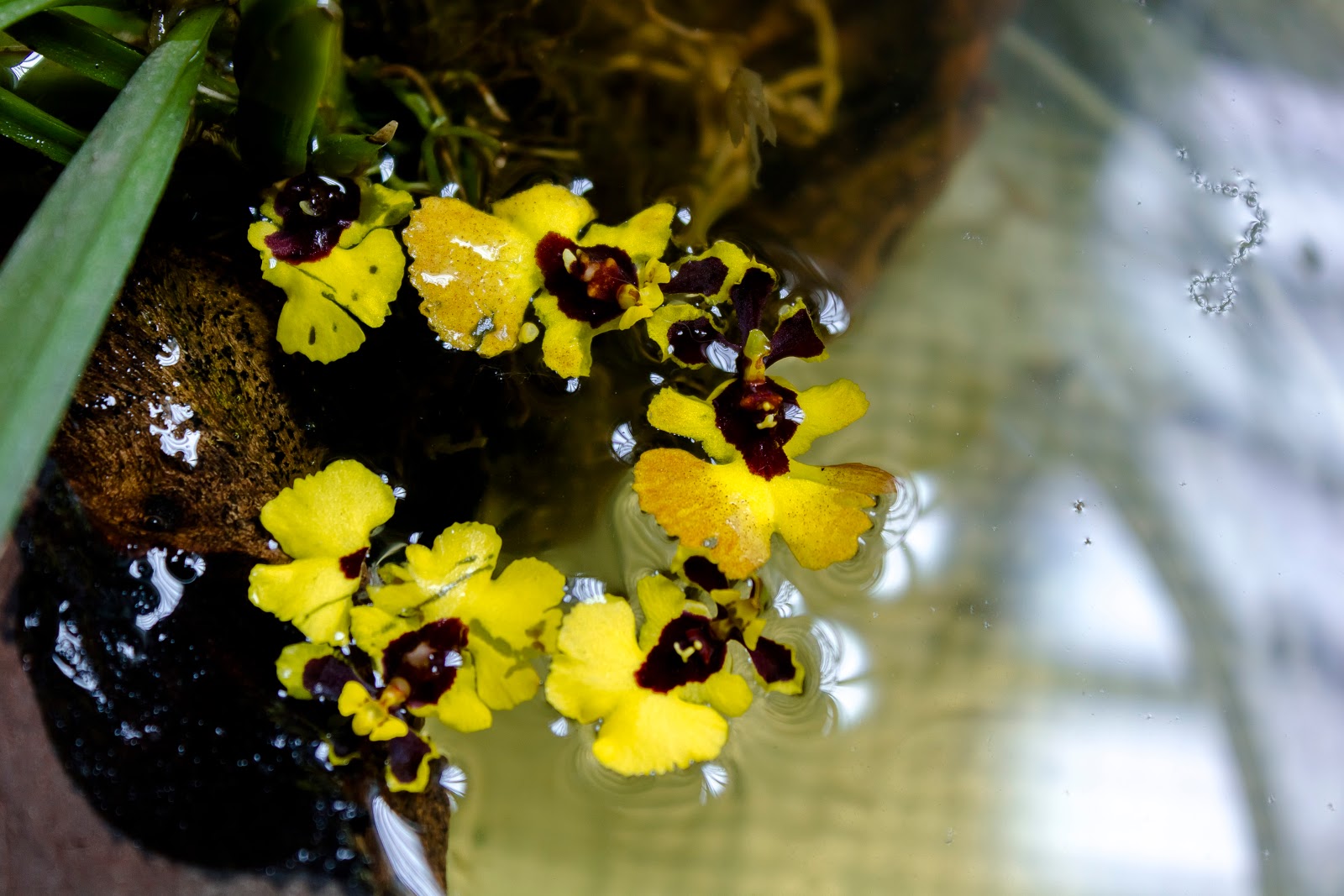
Tolumnia Genting Orange bloomed continuously for 3 months

Decapitated orchid blooms

     I was really excited about posting today that the third round of blooms on my Tolumnia Genting Orange were finally open.  But the cat got to them before I did.  I set the orchid to soak in the watering basin, went to make my breakfast coffee, and came back to find all the flowers floating in the water.

     As it stand, my Tolumnia Genting Orange bloomed continuously since May 29--almost 3 months of blooming.  If these flowers had survived, they would have lasted at least a month more.

Wednesday, August 15, 2012

Noid paph grows new leaves, but I wanted flowers

A noid paphiopedilum

     My noid paph is big, healthy, with many roots (for a paph) and many leaves.  But a year has passed since I purchased it in bloom, and it hasn't reflowered for me.  For a while I had been excited about its newest growth, but that turned out to be just another leaf.  That brings the leaf total up to 8.

Yet another new leaf

     When a mature and healthy orchid fails to bloom, the culprit is likely to be insufficient lighting.  Getting my noid paph to a spot where it can get more light turned out to be a tricky issue, however.  My lower shelf is set up to accommodate my 2-foot tall oncidium.  This leaves a smaller orchid like the paph too far away from the light source.  On the other hand, my upper shelf is too close to the lamp.  If I were to move my paph to the top shelf, its tallest leaves would be in contact with the lights (sure to guarantee burn damage).

Rearranged orchids

     I ended up rearranging most of my orchids, and repurposing an unused knife rack to prop up my paph by 8 or so inches.  Hopefully that will help.  At the very least, my orchids are now more efficiently arranged.


Tuesday, August 14, 2012

Added supports to paph seedlings

Paph. Adam Hausermann 'York' X Duncan York 'Good Show' seedlings

     My paph seedlings seem to be doing well.  They are both busily growing new roots and leaves.  Their tiny pots dry out quickly, so that I am able to water every 1-2 days, giving the little orchids plenty of water without risking rotting the roots.

     However, because they don't have many mature roots, these orchids are very unstable in their pots.  Every time I move the pots for watering, the paphs are liable to flop over at an alarming angle.  In an attempt to add some stability to the orchids, I added wire supports to the pots.  These are similar to what I used to prop up my vertically inclined paph noid, with good success.

     Also noticeable in the picture is the yellowing on the bottom leaf of seedling #2 (on right).  I expect the orchid to shed that leaf soon.