Saturday, June 30, 2012

Side spikes growing on Tolumnia Genting Orange

Start of new side-spikes towards the end of a bloom cycle


     One of the nice things I just learned about tolumnias, is that the blooming season is not necessarily over once the first round of flowers fades.  Although after two weeks in full bloom, most of the flowers quickly wilted, the orchid has started three new side spikes.  This means that there will likely be only a very brief interim (if any) between the last of the old flowers falling, and the first of the new flowers opening.


     Another interesting thing to note will be whether the subsequent blooms have as much variation in color and form as the first set.  I have not used any Superthrive on my orchids since coming home from Europe (adding only minimal fertilizer to the water), so I will be interested to see if removing the Superthrive will yield more uniform flowers.


Growing a new fan

     In addition to the activity on the spike, the tolumnia has started growing one new fan, and is also growing many new roots.

     All in all, I am thrilled with how this orchid is growing for me.


Friday, June 29, 2012

growing noid phal

A healthy noid phalaenopsis


     It's almost hard to imagine that a year ago, this little phal noid was clinging to survival, with only 2 good roots and ever diminishing leaf size.  Now, this phal is a picture of good orchid health.  It's grown 7 new roots since spring.  The new leaf maxed out at a respectable 5.5 inches (still shorter than the old long leaf on the right), and the orchid immediately started growing another leaf.


     I have the phal growing on my top shelf, very close to the lights.  However, unlike my Phal M.A.M (name too long to write out in its entirety), this noid has not produced any leaf color change in response to the high light.

Thursday, June 28, 2012

Aborted spike on psychopsis mariposa

A very dehydrated looking psychopsis

     It was bound to happen eventually; my psychopsis mariposa was far too dry and rootless to sustain a flower spike.  Once I noticed that the spike tip was dry and dead, I cut the entire spike off.  I also repotted the orchid into sphagnum moss, in hopes of maintaining a more even humidity around the orchid's base.  None of the old roots remain, so if this orchid has any hope for survival, it will have to grow new roots.

Drying spike on sick psychopsis


Sunday, June 24, 2012

Are cats safe for orchids?

What trouble will he cause?

     Little Shkoda (Ukrainian for 'trouble') came home with us last week.  For now the 3-month old kitten seems more interested in pestering people than orchids, but he also gets new ideas for mischief pretty much daily.

    Some online searching indicates that all orchids are safe and nonpoisonous for cats.  But what about the safety of my orchids?  

     I've found enough decapitated spider-plant blooms around the apartment to see what fate awaits my precious flowers, should the cat ever take interest in them.  However, the only interest that he's shown in the orchids so far, is to lightly swat at the cymbidium's long leaves while I'm watering.  

     Generally I shoo him away from the orchids, if he ever starts making his way into the shelves.  And I have a pot of cat wheat grass growing for him, should he ever decide he needs extra greenery in his diet.  

     If I'm lucky, I won't be posting any future mugshots of his guileless face next to a traumatized orchid plant... but following murphy's law, accidents will happen.  I think I'm okay with that, though. 


Friday, June 22, 2012

Final bloom opens on Cattlianthe Jewel Box 'Scheherazade' inflorescence

Ctt Jewel Box 'Scheherazade'

     The third bud opened yesterday.  It's significantly smaller than the first two flowers: width is 3 inches.  However, it's well formed and a deeper red than the others were (moving the orchid to a windowsill while the bud was developing seems to have helped enrich the color).

     I took a few photos in different light conditions, but getting the color to accurately show through was a challenge. (The top picture is about the most accurate)

     There is still a second sheath that hasn't bloomed, but I don't know if or when those buds will start developing.


Wednesday, June 20, 2012

Replacement Orchids

My new dendrobium victoria reginae as it arrived in the mail

     Faced with the decline of two of my orchids, namely the den victoria reginae and the psychopsis mariposa, I went and ordered two replacements.  I purposefully chose a different vendor for the replacement plants.

One flower bud on the old cane

     The new den victoria reginae is larger, and hopefully hardier.  The largest cane is 1 foot tall, with eleven 2.5-inch leaves.  There is one flower bud on the old cane, but I am keeping my expectations low in regards to flowers.  First, I need this cool-growing orchid to survive the 100F heat wave that is currently heralding the start of summer in NYC (my orchids and I live without air-conditioning).

Dendrobium victoria reginae roots

     I hesitated for a while in deciding how to grow my new dendrobium.  The last one had 'died' (the canes are leafless, but I am still watering periodically in hopes of encouraging some new growth), and I didn't want to repeat my past mistakes.  In the end I decided to go with the mounting route.  My previous den originally declined while I had it potted, and (except for the mishap while I was away on vacation) it seemed to be recovering well while growing on a mount.

     The roots on this den are of decent quality.  There was some ancient sphagnum near the base of the plant (which I removed) and I trimmed off many rotten roots.  However, there are many new roots tips, which which hopefully help the orchid adjust to its new setting.  These tips are an odd bright orange color, for some reason.

mounted dendrobium victoria reginae

    I mounted the orchid on a piece of aquarium wood, and perched it somewhat precariusly against the side of my shelf.  Here's hoping it grows well, because if it doesn't, then I'll sadly have to give up on this beautiful species.

Psychopsis Mendenhall 'Hildos' as it arrived in the mail

     As a travel companion for the dendrobium, I also ordered a replacement psychopsis.  For a mere $10 more in price, this beautiful new plant puts my sickly old psychopsis 'mariposa' to shame.  I absolutely love the deep green mottling on the thick waxy leaves.  There are 5 pseudobulbs, and the largest leaf is 10 inches long.  And as an added bonus, the orchid is in spike.

Healthy Psychopsis mendenhall roots?  Maybe not

     I tipped the orchid out of its pot to check on the roots, and was happy with what I saw.  These roots are healthy and firm, with several growing tips.  Since the media would not fit nicely back into the old pot, I up-potted the orchid into a slightly larger plastic pot, adding some extra media around the sides.  I tried to minimize any disruption to the roots as much as possible.

     If the flowers come out as beautiful as the leaves, then this just may become my new favorite orchid.    

Sunday, June 17, 2012

Tolumnia Genting Orange variation in blooms

Tolumnia Genting Orange

     I posted some earlier photos of my Tolumnia Genting Orange, but this is a more detailed description of the flowers.  

     The miniature orchid bloomed with a foot-long flower spike, and 26 one-inch flowers. The blooms are very faintly scented.  The flowers open a solid yellow color (with the brown centers) and develop an orange hue around the skirt after about a week.  The flowers also develop brown spots in the back.  I found the flower spike very difficult to photographs because the blooms opened facing every which way.

     It's now been 3 weeks since the first flowers opened, and a few of the oldest blooms have wilted.  Most of the spike is still blooming profusely, though.

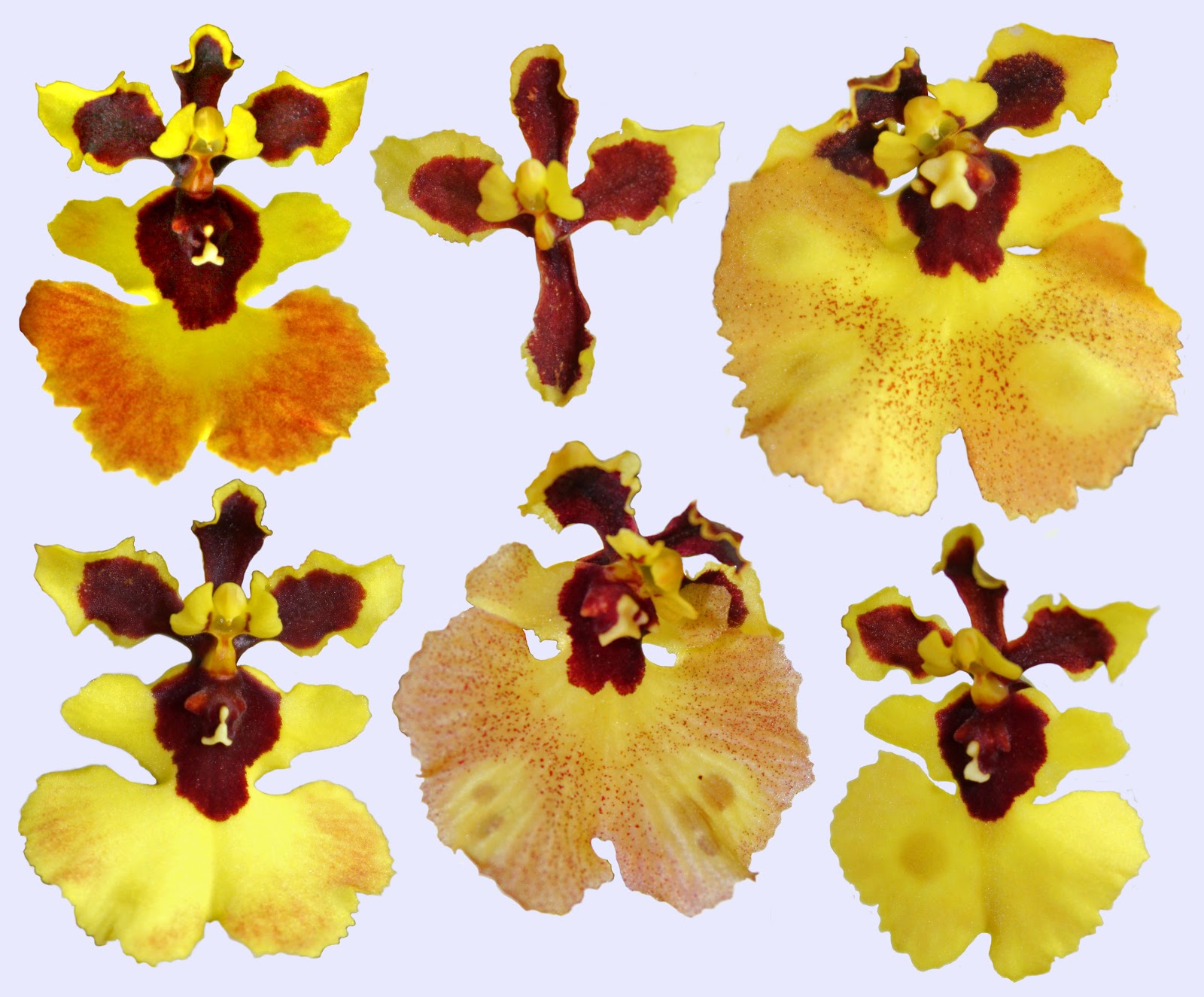
Variation in Tolumnia Genting Orange flower color and shape

    One interesting aspect of this blooming, is how different many of the flowers are from each other.  The picture above shows the variation of individual flowers on the spike.  The one on the top middle is clearly deformed (and there were a few blooms which looked like that), while the other flowers all look "normal". 
   
      I expect that the deformed flowers resulted from my recent Superthrive use, since others have reported too-high dosage leading flower aberrations.  I had only been using 1 drop into over a gallon of water, but since both this tolumnia, and my cattlianthe jewel box have recently produce some misformed flowers, I am concluding that even that tiny dosage was too high.  For now, I'm watering my orchids with pure water, and I will be diluting the superthrive much more in the future (most likely, 1 drop into a cup of water, and then a tablespoon of that water into a gallon of the final solution)

     However, even if the Superthrive explains the odd flowers, I think that the rest of the variation may be natural to this hybrid--which is really cool!  The pictures I found online tend to show only one type of flower per spike, but there is a lot of variation among the different photos:

Photo from Orchids by Hausermann (vendor)


Photo from Oak Hill Gardens (vendor)


    Judging by the difference among these pictures, it seems like most of my flowers fall within the common variation for this hybrid.