Saturday, October 13, 2012

New orchid: Aliceara Matthias 'Glamour'

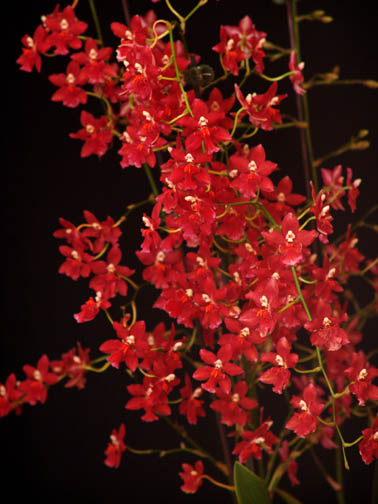
Aliceara Matthias 'Glamour'

     After my root health troubles with my existing two oncidium orchids, I wanted to buy a healthy one.  This is Aliceara Matthias 'Glamour', a red intergenic oncidium.  (A link to flowers photo)

Aliceara roots

     As far as health goes, this orchid is not much better off than my oncostele.  All the old roots on the left side of the picture are dead, although the new roots on the right are alive.  As a precaution, I soaked the orchid in fungicide before potting in the 3" slotted plastic pot seen in the picture at the top.

     The orchid has 4 mature pseudobulbs (3" tall) and one new growth.  The leaves are up to 14" long.  The orchid arrived looking fairly limp, but that's probably because it was shipped bare root.  The pseudobulbs are fairly plump, so this orchid should have plenty of reserve to adjust to my care.


Tuesday, October 9, 2012

Tolumnia Pink Panther doubles in size

Tolumnia Pink Pathner

    Back in May, I wrote about three (eventually 4) new growths on my Tolumnia Pink Panther.  In the 5 months since then, these growths have matured, and are now sending out 4 new growths of their own.  

New growth and roots on tolumnia

     The picture above shows one of the new growths, as well as the recent proliferation of roots.  The tolumnia now has 18 fans.  The orchid has quite literally doubled in size, since I first got it in April.

Tolumnia Pink Pather: 6 months growth

     The growths on the tolumnia wrap around its mount, making it difficult for a photo to truly capture its size.  Any angle I could use to take a photo would be missing at least a third of the fans.  However, compared to the photo from 6 months ago, the growth is evident.  The two pictures are at similar magnification (the size of the leaves is the same in both pictures above), but the orchid on right is much much larger, that it almost looks like a trick in perspective.

     When this orchid eventually gets around to blooming, I am expecting the show to be spectacular.


Monday, October 8, 2012

Repotting the spotted noid phal

A phalaenopsis in need of repotting

     Lately, my little noid phal has started to look like it's trying to climb out of its pot.  Several roots are growing up and out of the media, even as the pot itself takes longer than ever to dry out.  Checking my Orchid Descriptions list I realized that it has been over a year since I last repotted this orchid.  All signs indicated that it was time to switch out for fresher media.

Old (brown) and new (green) phalaenopsis roots

     When I took the orchid out of its pot, it became immediately clear why it had been showing signs of dehydration, even though the media had been taking longer than ever to dry out.

     The orchid had its two old roots sticking straight into the middle of the pot, while all the new roots had grown into a circle near the surface.  As a result, as I'd wait for the media to dry out in the center of the pot, the majority of the phal's roots would be bone dry and thirsting near the surface. 

Freshly repotted phalaenopsis

     I cleaned out the original pot, and potted the orchid back in with fresh media.  Soaking the roots in water for 15 minutes beforehand helped soften them, so I had no trouble tucking all the roots into the middle of the pot.  Now the media itself is more loosely packed, while the roots are more evenly distributed in the pot, which will help make watering more efficient.


Saturday, October 6, 2012

Potting the first of the phal keikis


Keiki orchid ready for separation from mother plant

     Phalaenopsis keikis are generally considered ready for potting once they have 2-3 leaves, and roots that are at least 3 inches long.  The roots on this 1-year old keiki are approaching 5 inches in length, and if they continued growing out any farther, then I would have struggled to find any pot to fit them.  It is time to remove the little guy from the mother plant, and pot it on its own.


Newly separated phalaenopsis keiki

     I cut the keiki from the spike with some wire cutters, sprinkled cinnamon over the cut to prevent infection, and left the keiki to soak in a tub of water for 10 minutes.  The water was treated with Superthrive, which should hopefully  encourage vigorous root growth.

potting a phal keiki

     Soaking the roots in water helped soften them so that I was able to (just barely) curl the 5-inch roots into a 3-inch clear plastic pot.  Although these roots are long, there are only two of them, and I worried that any larger of a pot would take too long to dry out.  

Newly potted phalaenopsis keiki

     The keiki is now potted in a 3" clear plastic pot, with phal bark mix.  I will now log it as a separate plant: Phal noid 'keiki 1'.

Phalaenopsis keiki

     I am trying something a little strange but possibly helpful with my second largest keiki.  Its roots are about 3" long, and I want to wait a little longer before removing it.  In an attempt to get the roots to curl into a pot-friendly shape, I tried strapping a plastic pot to the keiki while it's still attached to the spike.  This makes the spike quite top-heavy, so I added a support stake.  I'll see if this is more helpful than it is ungainly.  I expect to separate this keiki in another month.


Thursday, October 4, 2012

Flower buds on Sophronitis cernua

Sophronitis cernua

     Each of my two Sophronitis cernua orchids produced a new growth over the summer, which have now matured an opened.  One of these growths has something in the middle that looks like flower buds.

Flower bud on Sophronitis cernua

     The brownish segment on the left seems like the sheath, while the dark thing on the right seems to be a bud.  I am a little concerned by the blackish color of the bud.  It does not look very much like the macro photo of Sophronitis cernua buds here.  For now it seems to be growing, and I can only wait and see if it will bloom properly.


Tuesday, October 2, 2012

Twice-daily watering on vase-grown Angraecum leonis produced spurt of root growth

Angraecum leonis growing in vase

     About 1.5 months ago, I increased my watering of the Angcm leonis to twice daily in an attempt to simulate the monsoon season that this orchid experiences during the warm months.  My hope was that extra watering would encourage some faster growth from this very slow orchid.


New root tips on Angraecum leonis

     Within a couple weeks of the increased watering regime, the orchid activated new root growth, producing the branching seen in the picture above.  These new root branches now measure between 1/4"-1/2" long after 1.5 months growth.  I cannot conclude whether it was the extra water, or the additional exposure to Superthrive which directly caused this root growth.  

     I haven't notice any other changes in response to the twice daily watering.  Now that the weather has cooled down (and because watering an orchid twice a day is a pain the neck) I scaled my watering regimen back to once daily.

Angraecum growth progress over 1 year

     Although I complain about this orchid being the slow-poke of my collection, a comparison to my oldest photo of the plants does show a rather significant amount of root growth in the past year.  In fact, most of the roots in the December picture are themselves newly grown (they are a light green, in contrast to the darker tone of the old roots).  The truth of the matter is that the orchid arrived to me in poor health, and needs to regrow its root system before it can really start growing impressive leaves or buds.


Monday, October 1, 2012

Psychopsis Mendenhall 'Hildos' produces side spike

Psychopsis Mendenhall 'Hildos'

     Two weeks after getting mauled by my cat, this psychopsis has activated a side spike.  I may yet see blooms, if only I can keep the spike and buds and flowers away from my kitty's jaws!

Psychopsis starting a side-spike

     I've moved the orchid to as out of the way a spot as I could find (nestled between the orchid shelves, a white cabinet, the wall, and the watering bucket).  Hopefully between obstacles on every side, and a general policy of keeping cat out of the bedroom I will be able to keep this spike safe.