Sunday, July 29, 2012

A cat called trouble

Wilsonara Pacific Perspective (left) and oncidium noid (right)

     Last night I awoke to a loud crash sometime around 5am.  The cat, in the midst of his usual daybreak energy rush, had jumped up on the bathroom windowsill and knocked both flower pots onto the floor.  My beautiful ceramic orchid pot was shattered, but the orchids themselves suffered no harm.

     The accidental uprooting gave me an opportunity to see the root progress on these two recovering plants.  My Wilsonara Pacific Perspective had a nice cluster of new roots, as well as a few longer older roots that were still healthy.  

     The noid oncidium, on the other hand, it still rootless.  How does an orchid that has been rootless for almost a year still manage to be alive and so leafy?

     I potted the two orchids back in their original plastic pots, and put them back on the same windowsill.  I know I am pretty much asking to get them knocked off again by not changing their location... but I don't really have any other place to put them at the moment.  The cat tipped the noid oncidium out of 

Edit (7/31): It took less than a day.  The cat tipped the noid out of it's pot again.  I've moved that pot to a less sunny, but hopefully more cat-safe window.  The wilsonara seems to be more secure in its original location, since it's in a heavier clay pot. I've moved it to the corner of the bathroom window, so that the cat can have room to jump on the windowsill without disturbing the orchid.

Saturday, July 28, 2012

New Orchid: Phal Gold Tris 'Desk Pot'

Phalaenopsis Gold Tris 'Desk Pot'

     This is the last of my new orchids, and the only one that arrived in bloom.  I saved this post for last, in hopes that it would give the rest of the flower buds time to open.  Instead, all buds blasted, the oldest flower wilted, and only two flowers now remain in bloom.  It's common for phals to drop blowers after getting shocked into new growing conditions, and that's exactly what happened to me.

     The flowers themselves on this miniature orchid were a bit of a disappointment to me, and a reminder to research orchids online rather than trusting photos from the vendor's websites.  Here is what the picture on the website showed:

Phal Gold Tris as advertised: Link to plant listing

     I was really attracted to the contrast between the dark pink centers and the yellow of the petals.  The flowers I received were mostly pale yellow fading into white.  It's still cute, of course, but it's not what I wanted.  It is possible that differences in growing conditions may bring out more of the red, but searches online indicate that the pale yellow blooms I got are much more on par with the norm for this plant.

Phal Gold Tris 'Desk Pot' closeup, with and without flash

     Even with the plant I received, the lighting used in photography makes a big difference in the appearance of the plant.  Flash helps bring out a richer yellow color, as well as intensify the red on the lip.  Natural white light, on the other hand, makes a very accurate portrayal of how the flowers actually look to my eyes.

Phal Gold Tris roots

     The phal is relatively miniature, with 8 leaves ranging in size from 1.5" to 5.5".  The spike is 7" tall, and the flowers are just under 2" wide.  Since the moss on this phal did not look as fresh as on my other new phals, I decided to repot.  Peeling away the outermost layer of moss revealed a central core of packed older moss in the middle of the root ball (picture, above left).  This means that during last year's repotting, the vendor upgraded the phal to a larger pot without disturbing the root mass.  

     This is the same kind of up-potting that killed off the roots on my Wilsonara Pacific Perspective, although in that case I let the situation progress for many years before finally repotting the poor orchid.  In this case, the older sphagnum moss was still in fairly good condition, and all the central roots were alive.  They did however have many breaks, so I cut them off anyway.  The phal has plenty of healthy newer unbroken roots to support itself with.

     I repotted the phal into phal bark mix, since I am still not comfortable with using sphagnum moss for potting media.  It stays wet for so much longer between waterings, that I am constantly worrying about rotting my orchids' roots.  Maybe I'll come around to the benefits of moss media by the time I am ready to repot my two other new phals next spring.

     Ultimately, even though this is not quite the phal I wanted, it is still cute and appears to be in great health.  It did not cost all that much, so that if I find myself running out of shelf space for my more favored orchids, I won't feel guilty for bringing this one over to my windowsill at work.


Tuesday, July 24, 2012

New Orchid: Paph (Adam Hausermann 'York' AM/AOS X Duncan York 'Good Show')

Paph. (Adam Hausermann 'York' AM/AOS x Duncan York 'Good Show')

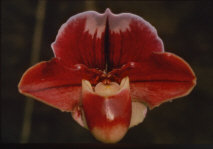
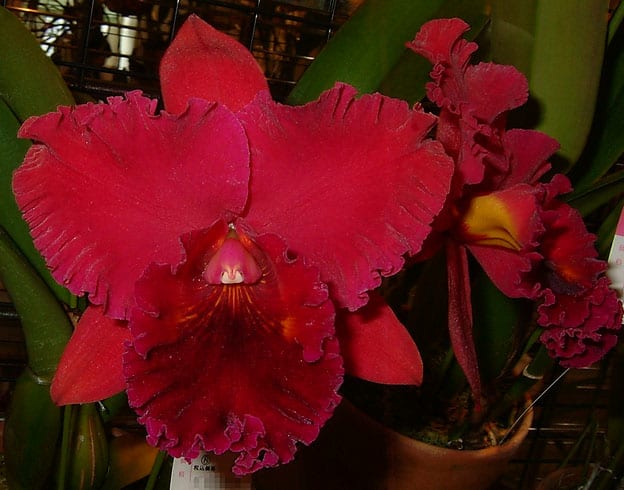
     This is a young orchid, probably far from blooming size.  I'm not really familiar with paph hybrids enough to guess how many years I'll have to wait to see it flower.  According to the vendor's description, this should be a 'red/mahogany complex hybrid'.  Finding large photos of the parent plants online proved challenging.  Follow the link below to "Waldor Orchids" to see a larger version of  a Paph. Duncan York cross.  Meanwhile, I found an image of Paph. Adam Hausermann, at a chinese website, which looks like another vendor, although I can't be sure.
Photo Source: Waldor Orchids
Paph. Duncan York 'Olympia'
Photo Source: Orchids.gr.jp
Paph. Adam Hausermann 'York' AM/AOS


     I expect to get big red flowers from the cross, which may or may not be spotted.


     When I went to repot the little orchid, I discovered a great surprise: instead of one paph with two growths, there were two separate orchids planted together in the pot.  Since these are seed-grown hybrids, the two orchids will produce different flowers if they both survive.

Two paph seedlings from one pot

     One of the seedlings was smaller than the other.  Both had a rotten root each, which I trimmed off.  Afterwards, the smaller paph was left with one good root, and the larger paph with two.  Both had nubs of new roots budding from the base.  Neither my noid paph nor my sanderianum seem to have very roots, so I am not too worried about the low root number.
     
     The larger seedling, (#1) has 5 leaves, while the smaller (#2) has 3 full-size leaves, and one new leaf just starting out.  The leaves are 3-4" long.  #1 seems to have fuller leaves, while #2 seems to have longer/thinner ones, but it's really too soon to tell if there will be a permanent difference in the growth habit of the two paphs.

newly potted Paph (Adam Hausermann 'York' x Duncan York 'Good Show') seedlings

     I repotted each of the seedlings into a slightly smaller 2" plastic pot, using the Paph&Phrag potting mix from repotme.com.  Both orchids were a little shaky in their new pots, but I'm hoping that with time, the media will compact a little bit and help with stability.

     Since the pots are so small, the media has been drying out fast enough that I'm watering the paphs daily.  Also, since I have so many new/newly repotted orchids, I am once again adding superthrive to the water.  I placed the seedlings on the top shelf where they are getting maximal light.  Hopefully these little guys thrive and grow well!  And if I'm lucky I'll see variety in the flowers.


Saturday, July 21, 2012

New Orchid: Dtps. Yu Pin Burgundy

Dtps. Yu Pin Burgundy

     This phal is slightly smaller than the Dtps. Jungo City, but not by much.  As the name suggests, this is another attempt on my part to purchase a red phal flower.  With 5 mature leaves up to 7" long, and one new growing leaf, I'm hoping I won't have to wait too long to see this phal flower.

     Like the other phals, this orchid came potted in sphagnum moss.  Since the moss looks really fresh, I'm holding off on repotting, and trying to water appropriately.  The moss takes longer to dry out than bark does, but the skewer method seems to work well enough.

Wednesday, July 18, 2012

New Orchid: Dtps. Jungo City

Doritaenopsis Jungo City

     Switching gears from the young phal gigantea, here is the largest of the orchids in my order.  Dtps. Jungo City is another of my attempts to acquire a red phalaenopsis.  While I'm not expecting any true scarlet out of this one, pictures online seem to show a very pleasing deep magenta for the blooms.

     The phal is fairly large, with the longest leaf measuring at just over 9".  The orchid is growing in sphagnum moss in a 5" plastic pot. There are 3 mature leaves, and one new leaf growing.  The roots near the base of the plant all seem firm and healthy, and I do not plant to disturb the media to investigate any further.

    Since the sphagnum looks really fresh and the orchid seems healthy, I decided to not repot.  I will try to continue growing it in the sphagnum for the next year.  I should be able to judge wetness of the media using the skewer method in the same way as I do with my bark mixes.

Monday, July 16, 2012

New Orchid: Phalaenopsis gigantea

A tiny giant: phalaenopsis gigantea seedling

     I've been interested in this phal species for a while now.  The infamously slow-growing phal can get huge: with 24" leaves.  However, the veritable giant of an orchid also comes with an equally giant price tag.  Mature specimens sell for hundreds of dollars.  I am not ready to shell out that much money for any orchid, much less a potentially temperamental species.

     So instead, I ordered a seedling phal gigantea which cost under $10.  This orchid will take longer to reach flowering size, than I will take to finish my PhD. But I am happy to sit back and patiently watch this orchid (hopefully) increase 12-fold in size.  

Phal. gigantea seedling roots

     The seedling is barely larger than my phal noid keikis.  At just over 2" long, its leaves are shorter, but the root system is more developed.  There are two long healthy roots (with some healed breaks), one areal root, and the start of a third root budding from the base.  I trimmed off two rotten roots while repotting.

     I unpotted the phal from its original container and moved it to a slightly larger 2.5" clay pot, with phal bark mix.

Phal. gigantea seedling

     The phal arrived with quite a bit of hard water staining (see top picture) which I tried to wash off as best I could using milk.  There are two leaves at 2" length, and the start of a new leaf.

    I'm curious who will compete for the title of 'my slowest growing orchid': the phal gigantea or my paph sanderianum!


Sunday, July 15, 2012

New Orchid: Rlc. (Port Royal Sound 'Big Red' x Chia Lin 'Shinsu #1' AM/JOGA

Rlc. (Port Royal Sound 'Big Red' x Chia Lin 'Shinsu #1' AM/JOGA)

     My giant orchid order from Hausermann arrived yesterday.  Since there are so many orchids (6), instead of one giant post, I will introduce each individually.

     So, without further ado, here is my new cattleya hybrid: a seed grown cross.  The tag says "Blc." for "brassolaeliocattleya" but a search on the Internet Orchid Register indicates that both parents were reassigned to the genus "rhyncholaeliocattleya" sometime around 2009.  Both these genus names are obscenely long, so I will refer to the orchid either as a 'cattleya' in general, or as 'Rlc'.

     The orchid has 4 single-leaved pseudobulbs.  The longest leaf is 5.5" and there is one new growth.  According to the vendor, it is 3 years away from blooming size.


     The picture above are hits on google image search for the parent names. Both seem to make large showy red flowers.  I expect and hope that my resulting hybrid will come out looking similarly.   

Bare root Rlc. Port Royal Sound x Chia Lin

     Since the orchid looked like its roots were trying to crawl out of the pot, I immediately went to re-pot.  I soaked the orchid for a while in water+superthrive to loosen everything up.  Then I pried the whole thing out of its 2.5" pot.  The roots inside were better than I had expected, actually.  Compare my Tolumnia Genting Orange, which arrived similarly with tons of roots outside the pot: the roots from inside the pot were mostly dead.

     I trimmed back a few of the dead and broken roots, and repotted into a 4" clear plastic pot with medium orchid bark.