Showing posts with label oncostele pacific perspective. Show all posts

Monday, April 1, 2013

Repotting Oncostele Pacific Perspective

Oncostele Pacific Perspective
 
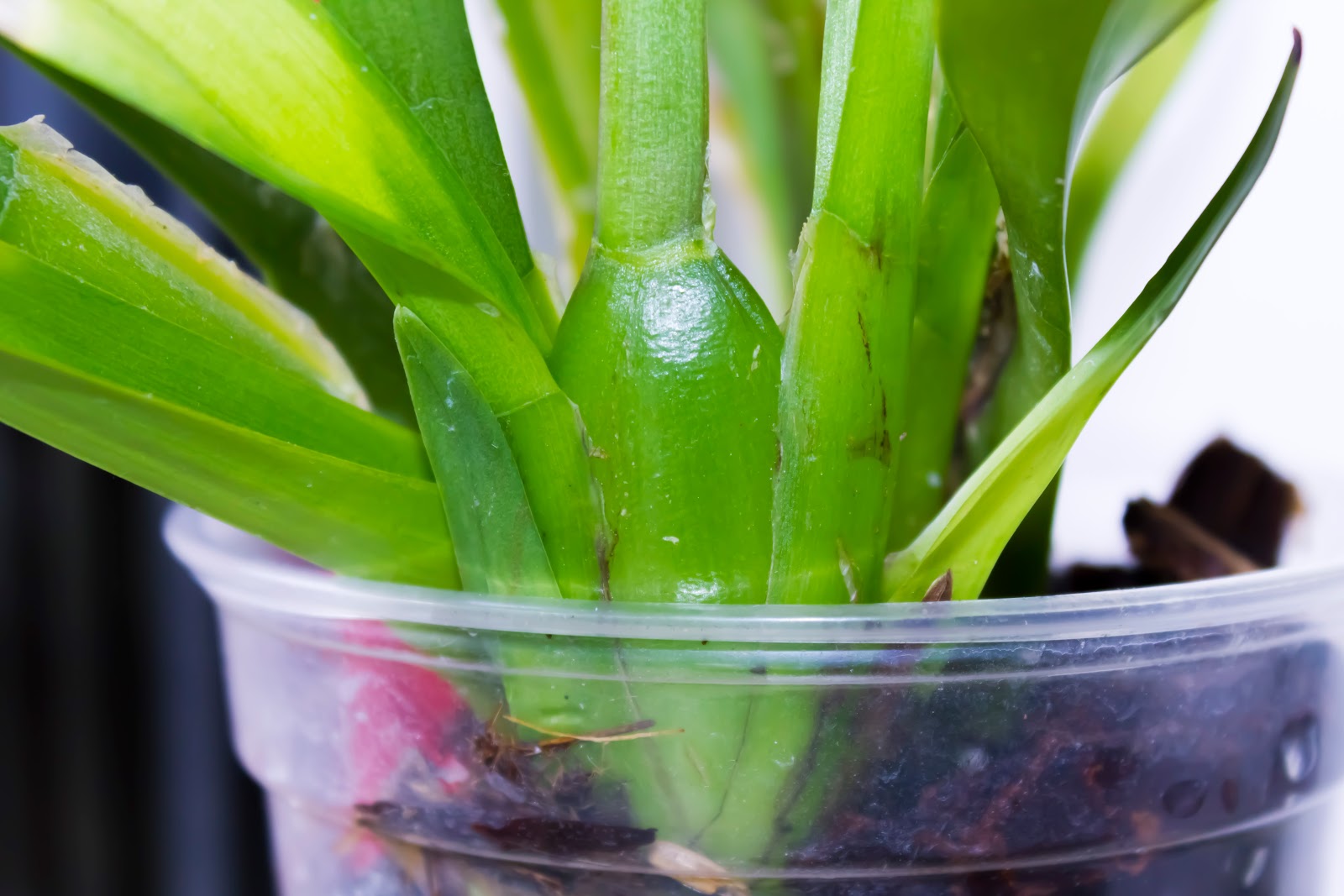
     On the same day as the Dtps. Yu Pin Burgundy repotting, I also moved my Oncostele Pacific Perspective to a larger pot.  The orchid had grown so many roots, that I simply could not keep up with watering it frequently enough in the old 4-inch pot.  You can see in the picture above how the pseudobulb on the far left is starting to wrinkle.  All those creases have since evened out once I moved the orchid to a larger pot which stays moist for longer.
Oncostele Pacific Perspective
 
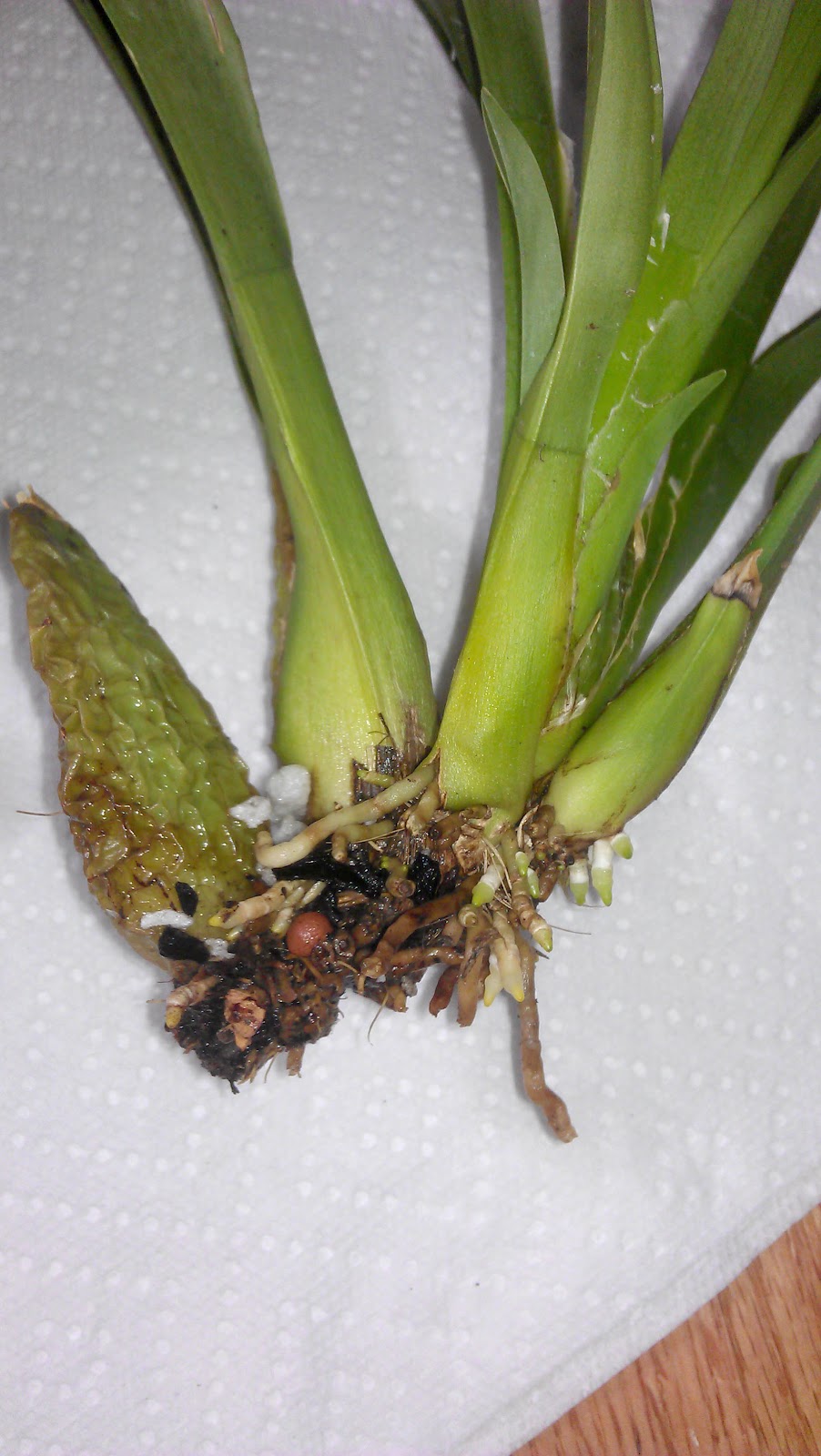
     The roots on the oncidium intergenic were healthy and numerous.  I barely had to do any trimming to clean up dead material.  Impressively, all this root growth is less than 6 months old.
Oncostele Pacific Perspective

     The orchid is now housed in a shallow 5-inch plastic pot, which will hopefully hold it for the rest of the year.  Its two new growths are now maturing quickly, and promising to grow quite large.


Tuesday, January 29, 2013

Two new growths on Oncostele Pacific Perspective

Oncostele Pacific Perspective

     The two newest pseudobulbs on this oncidium have matured and have now produced two growths of their own.  This probably means that the orchid won't be blooming for me this season.  However, I am perfectly happy with that if it means a larger show next year.

New growth next to newly matured pseudobulb

     The roots have grown quite aggressively since the last repotting in September.  At that point, the orchid was losing pseudobulbs to rot and had hardly any roots at all. Fungicide treatment appears to have fixed the rot issues, and now the orchid looks like it needs another repotting to a larger pot already.  How much longer should I wait?

Another new growth

Sunday, November 4, 2012

Oncostele finally grows long healthy roots

Oncostele Pacific Perspective

     Its foliage is blemished and its pseudobulbs reduced, but my Oncostele Pacific Perspective is finally showing a definitive sign of recovery.  After over a year of false starts, this orchid has grown roots that are long and healthy, and reaching the bottom of the pot.  

healthy oncidium roots

     The turning point was when I treated the orchid with a systemic fungicide back in late September, following a helpful tip from an anonymous commenter.  Within a couple weeks, I noticed new growing roots through the clear plastic.  Since then, they've grown longer and more numerous, and show no signs of dying back. 

small new healthy oncidium pseudobulb

     In addition, one of the new growths has matured, revealing a small new pseudobulb.  Although it is but a fraction of the size of the bulbs that this orchid lost a few months ago, its the first pseudobulb to appear which is completely unwrinkled.  With continuing vigorous root growth, I hope to keep it this way. 


Sunday, September 9, 2012

Another bulb rots on Oncostele Pacific Perspective

Rotten pseudobulb on oncidium (right)

     My Oncostele Pacific Perspective lost another pseudobulb yesterday.  Although it still had green leaves attached, the bulb had turned mushy and had to be excised. This is the second pseudobulb to rot since it rotted its last one in May.  I am not sure what's causing this rot.  Generally orchids rot when there is too much moisture that is not drying out.  But if anything, I haven't been watering enough; the leaves on the newest growths are wrinkled from dehydration.  

     My guess would be that these problems arise from the orchid not having enough roots.  With its many old pseudobulbs, the orchid would not fit into any pot small enough to be appropriate for its root size.  As a result, the media would be both too dry near the top where many of the new roots were growing, and permanently soggy elsewhere, leading to bulb rot.

Oncostele Pacific Perspective

     Once again diminished, the oncidium is now in a 4 inch clear plastic pot, with loosely packed oncidium potting media.  There is a good amount of new root growth, which will hopefully support the two new growths as they mature.


Monday, August 20, 2012

Name change: Wilsonara Pacific Perspective = Oncostele Pacific Perspective

Oncostele (Wilsonara) Pacific Perspective

     I was searching around on the International Orchid Register today, when I noticed that my oncidium intergenic has been reclassified into a new genus.  My wilsonara is now officially an oncostele. The change doesn't really mean much to me, but I generally try to stick with the most recent official classifications of my hybrids.

     I had the oncidium growing on a sunny bathroom windowsill over the summer, and the bright light resulted in quite a bit of leaf damage on this oncidium.  I'm switching this orchid's placement with my cymbidium, which should be better able to to handle the hours of direct sunlight on the windowsill.  The oncostele is going to my orchid shelves to grow under the lights, and I'm putting the Cym. (Gordon Gibbs x Billion Dollar Baby) on the windowsill instead.

Sunday, July 29, 2012

A cat called trouble

Wilsonara Pacific Perspective (left) and oncidium noid (right)

     Last night I awoke to a loud crash sometime around 5am.  The cat, in the midst of his usual daybreak energy rush, had jumped up on the bathroom windowsill and knocked both flower pots onto the floor.  My beautiful ceramic orchid pot was shattered, but the orchids themselves suffered no harm.

     The accidental uprooting gave me an opportunity to see the root progress on these two recovering plants.  My Wilsonara Pacific Perspective had a nice cluster of new roots, as well as a few longer older roots that were still healthy.  

     The noid oncidium, on the other hand, it still rootless.  How does an orchid that has been rootless for almost a year still manage to be alive and so leafy?

     I potted the two orchids back in their original plastic pots, and put them back on the same windowsill.  I know I am pretty much asking to get them knocked off again by not changing their location... but I don't really have any other place to put them at the moment.  The cat tipped the noid oncidium out of 

Edit (7/31): It took less than a day.  The cat tipped the noid out of it's pot again.  I've moved that pot to a less sunny, but hopefully more cat-safe window.  The wilsonara seems to be more secure in its original location, since it's in a heavier clay pot. I've moved it to the corner of the bathroom window, so that the cat can have room to jump on the windowsill without disturbing the orchid.

Thursday, June 14, 2012

Assessing the damage: coming home after two weeks away

The orchids were somewhat rearranged when I came back

     I left my orchids in the care of my bf during the two weeks that I was away, with the instruction to water all the mounted orchids every other day, and the potted ones whenever the wooden skewers tried out.  On my return, I found that most of my orchids were happy, a few had thrived, and only one suffered drastic damage.

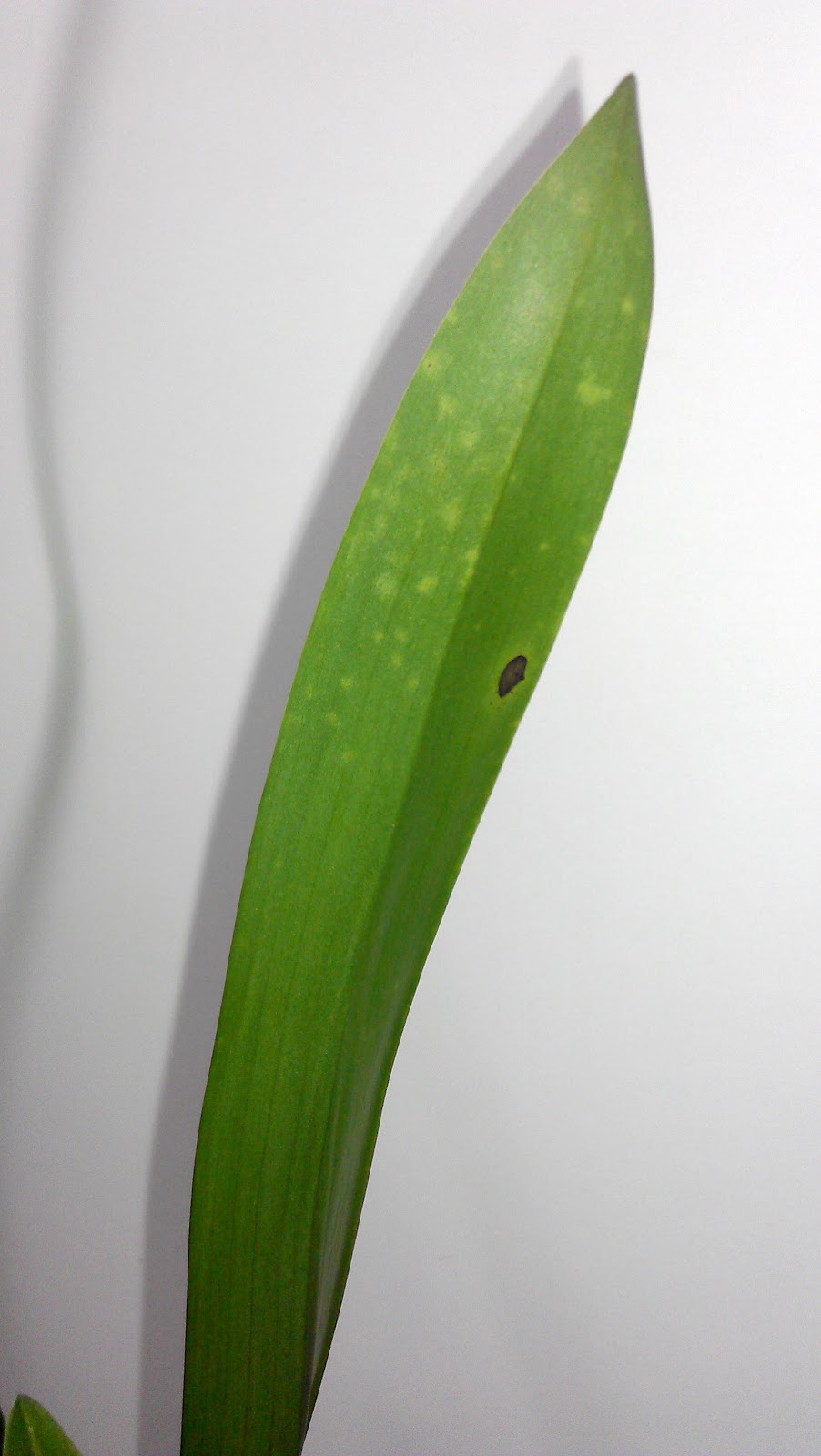
     The first thing I noticed when I got home was that my orchids were all in different places than where I had left them. Most of this was not a problem, but the wilsonara at the top shelf had its leaves directly up against the lamp, which resulted in some lamp burn.

Sunburn damage on oncidium leaf

    A number of my oncidium and cymbidium plants lost a leaf or two over the last few weeks, but are otherwise fine.  In fact, the only 'casualty' from my two weeks away was my dendrobium victoria reginae.  It lost the one leaf it had, and the new cane growth dried up and died.  It roots are fine, and the canes aren't dehydrated, but I don't know if this particular den will successfully recover.  I ordered a replacement plant for in case it doesn't.

Wrinkling on psychopsis leaf shows dehydration

     The psychopsis looked very dehydrated.  I think in part, it's because I told bf to water it every other day (for simplicity of instructions and to avoid risk of overwatering) and in this case that wasn't often enough.  However, when I checked it's roots, I found that they were all hollow.  This would be no fault of bf's care, but rather the consequence of this plants poor health from the very beginning.  It's spike is still growing, but I don't know whether to expect it to bloom, or if it will survive or not.  In any case, I ordered another psychopsis as a travel companion for the new den victoria reginae.

Cattlianthe Jewel Box 'Scheherazade' flowers going out of bloom

     My cattlianthe flowers were already wilted looking by the time I got home.  They were also far less red than the earlier photos suggested.  Since the orchid was already getting the maximal amount of light it could handle, it must be the temperature which adulterated the blooms' color.  There is a third flower forming on the spike, and I moved the orchid to a windowsill, in hopes that the cooler air would help it develop a deeper red.  I'm not sure how successful my attempt will be however, since the weather is only getting warmer, and the flower bud is already pretty well developed.

New cattlianthe pseudobulb

     The new pseudobulb has nearly tripled in size over the last two weeks. Here is how the growth looked just two weeks ago.

Tolumnia Genting Orange

     Fortunately, my Tolumnia Genting Orange is in full bloom and going strong.  The flowers opened facing every which way, making the blooms hard to photograph.  I'll do a more detailed post on the orchid later.

New roots on Phal Memoria Audrey Meldman 'Mendenhall'

     My phals seemed to thrive under my bf's care, producing tremendous root growth.  For the rest of the orchids that I didn't mention--there were no notable changes.  They had neither grown nor suffered in my two weeks' absence.

     The bottom line seems to be that phals really are good beginner orchids, as they seemed to be the happiest under my bf's care.  My paphs probably come in as a close second, since none showed any signs of stress when I came back.  And finally, the only one of my orchids that really deteriorated, was one that was sickly to begin with.

Friday, May 11, 2012

Repotting my oncidiums into proper media

Removing a rotten backbulb

    I said at the end of last month, that I would wait until my Wilsonara (Oncostele) Pacific Perspective was out of bloom, before repotting and removing the rotting backbulb.  Well, last week my new oncidium media arrived from repotme.com, and the oldest two blooms on the flower spike wilted.  So I decided it was about time to do some plant surgery.
     
     I used some big scissors to cut off the rotten bulb, and sprinkled cinnamon over the cut (to help prevent rot or infection spreading through the cut site).  The remaining bulbs are firm and healthy.

Short roots bristling with growth indicate a problem with the potting condition fungal infection

     The state of the roots showed that this orchid was not happy in its old potting media.  Although many of the roots from my december update are still alive, all remain very short, as if they did not want to grow any further into the pot.  The blackened tips on roots that are less than 5 months old (see above) likewise indicate unwelcome conditions.

Wilsonara in oncidium orchid mix and clear 4" pot

     I repotted my wilsonara into a clear 4" pot, which is slightly narrower and deeper than the previous pot.  Now that I have one bulb fewer, I can fit the orchid into a smaller container.  Since the plant is still extremely  top-heavy (and fell out of the new pot as I was moving it around), I also placed the plastic pot inside a slightly larger ceramic pot for extra stability.

Oncidium root deterioration after 4 months in unfit media of untreated fungal infection
     
     Since my wilsonara wasn't doing too well, I decided to also repot my oncidium noid into the new media. I am glad I did, because the oncidium noid's condition was much worse than the wilsonara's.  The few roots that had grown in January, were now almost completely rotten.

oncidium root buds that failed to grow
After trimming dead roots: a nearly rootless oncidium remains

     I'll admit I was pretty brutal in trimming off the dead root material.  In part, I did it because I didn't want any rotting dead plant matter to corrupt the newest growing root tips. 

     But a greater part of my aggressiveness in the trimming came from the fact that I really don't care about the fate of this orchid.  It's a noid that I bought on the cheap, and have never seen in bloom.  I don't know if I will like its colors, or even how long it will take to recover enough to bloom for me.  It's a large, sick orchid, with pretty green foliage... but that large green foliage is also a pain when it's taking up valuable space under the grow light.  (And after the repotting, I moved the orchid to a windowsill for that reason).

New root tips budding from new growth on oncidium

     Still, even this sad rescue is putting forth a vigorous effort at growing new roots, with both of the newest growths bristling with little root tips.

     My conclusion from this experience is that 'paph&phrag' media does not make a good substitue for other fine-rooted orchid types.  Just as my dendrobium victoria-reginae suffered until I moved it out of the paph&phrag media and onto a mount with moss, so did my two oncidiums struggle to grow healthy roots while potted into that media.  

     As my paphs are growing happily in it, I don't think the media mix itself is bad, but I do think it's clearly not compatible with other orchid genera.  The new oncidium mix is much more solid, and provides a greater stability to the potted plant. If I'm right, and the mix was the problem, then I can hope to see healthy long roots on both my oncidiums by the end of summer.

EDIT (11/4): I'm now convinced that the root problems on my oncidiums were the result of fungal issues, rather than improper media.  I've since treated my orchids with systemic fungicide, and am finally seeing good progress in root health.

Tuesday, April 24, 2012

Mushy backbulb on Oncidium

The brown part of the backbulb feels hollow and mushy

     The oldest pseudobulb on my Wilsonara Pacific Perspective is rotting away.  The brownish portion of the pseudobulb (whose color the camera flash so nicely accentuates) is hollow and mushy on the inside.

    I don't want to repot the orchid now, since it's in full bloom, and I don't want to risk losing the flowers early.  The roots seem healthy, so I hope I am not making a big mistake by waiting.  But as soon as a blooms fade, I will be repotting, and cutting off the rotten bulb.  I will also be switching to a different potting medium, perhaps one specifically formulated for oncidiums.  Currently I have it potted in paph&phrag mix, because it's a fine-grade mix and the oncidium's roots are thin.  But the rot seems to indicate that it needs a change.

Friday, April 6, 2012

Wilsonara Pacific Perspective Time-Lapse


     Here is my first attempt at putting together a time-lapse of an orchid bloom.  It's far from perfect, but I am pleased with the results for a first attempt.  

     Lessons to be applied to future attempts will include staking up the flower spike to prevent it drifting across the field of view, and take better efforts to keep the background clear of clutter.  Also, it seems that even in the early days when the flower buds don't seem to be doing much in the way of growth... they are surprisingly mobile.  And when they do open, the final unfolding seems to take place over the course of only a few hours (and in the case of this wilsonara, very early in the morning while I'm still asleep).  For these pictures, I chose the less demanding frequency of taking photos once daily (increased to 3x per day when the buds were about to open).  I will try to increase the frequency of pictures for next time I try this.

In the meantime, here are some more photos of the Wilsonara Pacific Perspective in full bloom.


Thursday, March 29, 2012

Noid no more: presenting the Wilsonara Pacific Perspective


     Within hours of me posting to the Identification subforum of the Orchid Board, a user 'WhiteRabbit' found a named match for my red oncidium.  My orchid, is very likely called Wilsonara Pacific Perspective.  The 'Wilsonara' genus is an intergenic of three orchid genera: cochlioda, odontoglossum, and oncidium.  While it is rare to be able to identify an intergenic orchid noid, the similarity between the blooms is so compelling, that I am convinced.  

Here are some more comparison pictures I made, joining my photos with similarly lit image search results:


So are you convinced?  I think I am. 


Wednesday, March 28, 2012

First blooms open on oncidium

A delicate veining of the petals shows through in the sunset light

     It's finally happened!  Almost exactly 2 months after I first noticed a spike, the first flower buds are opening.  It's a relatively small flower spike: only 6 blooms.  Once the orchid's roots have further recovered, I expect to see bloomings that match its former glory: flower spikes over 3 feet high with dozens and dozens of blooms.  For now, I am certainly enjoying my first orchid blooming since moving to New York!

     The flowers are about 2.5 inches across, in either direction.  They also have an odd sort of spicy/musky scent.  I can't quite decided whether I think it's pleasant or not.
how the color looks to the naked eye in diffuse light: a kind of terra-cotta earthy red

     
I edited the color tones in the above photograph to match how the orchid's color looks to my eyes, since my camera was making the reds of the petals and the yellows on the lip stand out much more than I could see. 

camera flash gives the blooms a lovely waxy red tinge, but looks nothing like what I see with my eyes

     All the three closeup shots of the blooms look very different due to changes in lighting.  One might think they were three different flowers!

two buds fully open, one partly open, and three flower buds still developing

     As you can see in the last picture, the inflorescence is not yet in full bloom.  I'll post an update once the last buds open.  In the meantime, I'm taking advantage of my tripod to put together some timelapse videos of the opening flowers.  It won't be the professional level, since I can't sit at home taking a photo every 30 minutes for a month as the flowers open (nor do I have the setup for an automatic shutter), but it's still pretty cool ;-).  

     If anyone seeing this has suggestions for what might be the name of this lovely noid, I'd love to hear any ideas!

EDIT 3/29: Identified as Wilsonara Pacific Perspective!

Wednesday, March 21, 2012

New growths abound

new growth on blooming oncidium

     It seems that my orchids have picked up on the spring season, and responded with an abundance of new growth.  Above, is a tiny new growth on my currently budding oncidium noid.  Meanwhile, many other orchids are throwing out new leaves and pseudobulbs galore.

New leaf on phal: with 5 new healthy roots, I'm hoping this leaf won't end up stunted like the last 3 did

hint of new leaf on my slowly developing keikis from the bigger phalaenopsis noid

the start of a new pseudobulb on my Cattlianthe Jewel Box--good omen for repotting success?


Sunday, February 5, 2012

Oncidium flower spike--One week of growth

A sequence of growth


     I estimate that the spike had been growing for 1 week hidden within the folds of the leaves before I first noticed it.  Based on that count, the picture above shows growth from days 7, 11, and 13.  The spike quickly acquired a dark burgundy color, which matches the color of this orchid's blooms.  On day 12, I carefully pried the tip of the spike out of the leaf fold, and overnight, the spike straitened out to what you can see in the rightmost picture.


EDIT 3/29: Identified as Wilsonara Pacific Perspective!

Monday, January 30, 2012

Oncidium flower spike!

 
     I was so excited to spot this last night.  This is not an orchid I expected to see blooming any time soon (its roots were in pretty bad shape). I am really hopeful that the flower spike takes, as it is probably my favorite among my plants. It aborted a flower spike last year due to poor potting conditions, so here's hoping that this time I'll do better.
     I'm not sure what triggered it--perhaps the apartment has been a little colder, or that I changed my watering style to be more conservative.  Now that the spike is there, I will be watering the oncidium with a low nitrogen bloom booster fertilizer, but otherwise trying to keep the conditions as stable as possible.
     One interesting note is that this spike showed up really suddenly.   Just a couple days ago I was looking at the wrinkling on the little leaf with concern (a sign of dehydration/root issues) and there was no sign of the spike.  I'll be keeping close tabs as the spike grows and develops over the next several weeks.


yay! :-)


Edit 3/28: Now blooming!
EDIT 3/29: Identified as Wilsonara Pacific Perspective!

Thursday, December 22, 2011

Oncidium NOID: a set-back

poor root health

     While watering my orchids the other day, I accidentally jostled my old oncidium NOID, and the plant fell completely out of its pot.  This exposed the rather pitiful current state of its roots, which is quite worse than what I had hoped.  Aside from the one longish root at the upper left of the picture, the plant's only living roots are the new growing tips.  Although the oncidium has been sprouting roots continuously for the last 2 months, they haven't been surviving.  I trimmed back a few rotten dead roots (long root on bottom right).
     The lack of roots and the ease with which the orchid tipped out of its pot both indicate that I had originally placed it in way too large of a pot.  To correct the situation, I searched for the shallowest pot I owned that would still be wide enough at the top to fit the oncidium's pseudobulbs.  The smaller new pot allows the plant to be more stable, and the smaller volume of media will be able to dry out faster.  Both of these changes should help improve the orchid's root health


comparison: oncidium in new, much smaller pot


     Since the pseudobulbs still have much more thickness than the ones on the oncidium 'the rescue' NOID I am not at this point worried about losing this orchid.  However I am disappointed that my 'NOID isn't farther along in its recovery.  I really hope the smaller pot helps, but the timeline before I can hope to see my favorite old orchid bloom again seems even longer now.


EDIT 3/29: Identified as Wilsonara Pacific Perspective!

Saturday, December 17, 2011

Oncidium NOID: the faded glory


     This oncidium NOID is the only other orchid to have survived the move with me.  I picked up the plant 2 years ago at a farmer's market with a 3 foot tall spike resplendent in burgundy blooms.  A plant so large was a sure bet to rebloom for me year after year, I thought.  If I knew then what I know now, I would have seen the signs of trouble.  Within two weeks, it dropped most of its flowers, and has sulked since.


wrinkled pseudobulbs are a sign of trouble


     Two years later, after some reading on proper oncidium care, I finally got suspicious about the state of the plant.  The pseudobulbs on this plant are all strongly wrinkled, which is a sign of dehydration.  While it is natural for old pseudobulbs to wrinkle slightly over time, the newest growth (top right of picture) should be plump.  The wrinkled state of these pbulbs are a clear sign of root trouble.  Another red flag is that the newest pseudobulb is only half the size of the two older ones.  If an orchid is healthy and growing, then new growths should never be smaller.  In the very top picture of this post, you can also see wrinkling on the two leaves at the front.  The wrinkling indicates that the orchid was not getting enough water at the time when those leaves were forming.


     When I finally got around to repotting the plant, the plant fell out of its oversized 8-inch pot... with the roots contained within the shape of a smaller 5" diameter mass.  The rest of the outside pot was filled with badly decayed wood shavings, and contained no roots at all.  Meanwhile in the heart of the root mass I found a smaller 2.5" plastic pot buried around the oldest growth.  This plant has not been properly repotted since it's very first deflasking!


    Lesson learned: always repot an orchid when you first get it.  You never know the true health of a plant until you see the state of its roots, and even reputable seeming vendors can sell orchids which are in bad need of repotting.


After I finished cutting away the old plastic from the root mass, the plant was left with very few healthy roots.  Within weeks of the repotting however, the young growths sprouted a veritable pincushion of new root tips.


A few weeks after re-potting: you can almost hear its sigh of relief

The roots today

Even a couple months after the initial repotting, the plant continues putting out roots.  Some of the initial roots have failed, while others seem to have established themselves (the white roots on the left).  Meanwhile, the leaves on the new growth have since doubled in size. 

I particularly like the purple tinge on the new growths

 I am a little concerned by the black spots on the top of the new leaves though.  I'm not sure what caused this damage, but at least it hasn't progressed since first appearing.

water damage or lampburn?

The plant still has a ways to go before it fully recovers.  Oncidiums bloom from new pseudobulbs, and since the newest pbulb has already aborted an attempt at blooming, I will likely have to wait for a new pseudobulb to grow before I can hope for a flower spike. I guess I will have to be patient before I can hope to see those gorgeous blooms again.

EDIT 3/29: Identified as Wilsonara Pacific Perspective!