Showing posts with label root health. Show all posts

Tuesday, January 17, 2012

Oncidium NOID: the rescue orchid recovers

new growths on the left and right sides of the plant

     My oncidium rescue has been slowly growing for the past few months, with two new growths on opposite sides of the plant.  The one on the left picture is clearly visible, while the one on the right is mostly hidden within the folds of a larger leaf.  Since I was in a repotting frame of mind after dealing with my den victoria-reginae's troubles, I decided to pop the incidium out of its pot to take a look at the root situation.

picture on right shows the very first pseudobulb: small and withered now

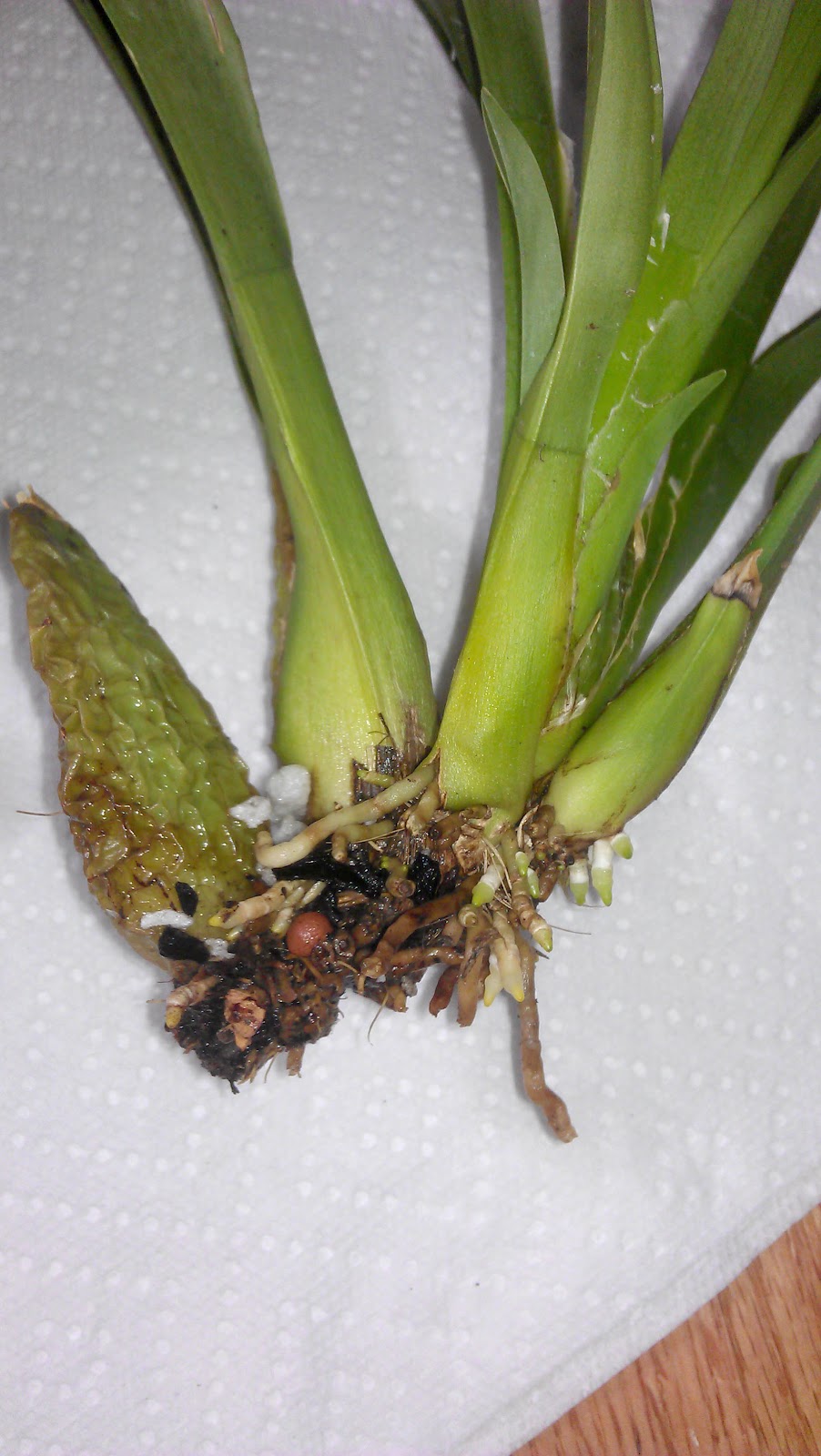
     As you can see in the picture above, this orchid does not have much roots.  Most of the rootlike stubble that you see is actually where I had trimmed back the dead roots months ago soon when I first bought the orchid.  The only living roots are the 5 longish roots on the very left of the picture.  These have been growing out from the newest big growth.  I noticed that with oncidiums, roots seem to only grow from new parts of the plant.  The old pseudobulbs seem to be entirely inactive.


     Bringing the new roots into closeup, you can see 3 new root tips sprouting out.  Although none of these roots are green, it is not atypical for roots growing without light.  The new root tips make irrefutable proof that these roots are alive.


     Meanwhile, further up on the same growth, 3 new roots are showing through.  Since these roots sprouted above the level of the potting media, they are green colored.

oncidium in new pot, now closer to the lights

     I had last repotted this oncidium in the fall.  Although such frequent repotting is not ideal for orchids, I had several reasons to repot at this time anyway.  

     First, the media I had used last time was not the best for oncidium roots.  I had used the typical coarse orchid mix that phals are often potted in.  However, the rule of thumb is: the thinner the roots, the finer the media.  Oncidium roots are much thinner than those of phalaenopsis.  This time I used some "paph and phrag orchid mix" from repotme.com, which is better suited for thin orchid roots.  Perhaps for future repottings I will purchase media specifically formulated for incidiums, but for now I saved money by using what I had at hand.
     
an ideal orchid pot would have lots of drainage holes


     Second, I wanted to switch the orchid to a better pot.  The previous container had only one drainage hole in the bottom, while the new one has 8.  Better drainage will help the media dry out faster and prevent root rot.


     Also, last time I had managed to pot the orchid at a crooked angle.  Repotting allowed me to correct that. And finally, checking on the state of the roots lets me know if I am properly caring for the orchid and catch potential problems early.  Meanwhile, since the orchid has so few roots, repotting is less likely to disrupt the orchids health.  Unlike with overgrown orchids, this oncidium comes out of its pot easily, without breaking off delicate root tips.

Thursday, December 22, 2011

Oncidium NOID: a set-back

poor root health

     While watering my orchids the other day, I accidentally jostled my old oncidium NOID, and the plant fell completely out of its pot.  This exposed the rather pitiful current state of its roots, which is quite worse than what I had hoped.  Aside from the one longish root at the upper left of the picture, the plant's only living roots are the new growing tips.  Although the oncidium has been sprouting roots continuously for the last 2 months, they haven't been surviving.  I trimmed back a few rotten dead roots (long root on bottom right).
     The lack of roots and the ease with which the orchid tipped out of its pot both indicate that I had originally placed it in way too large of a pot.  To correct the situation, I searched for the shallowest pot I owned that would still be wide enough at the top to fit the oncidium's pseudobulbs.  The smaller new pot allows the plant to be more stable, and the smaller volume of media will be able to dry out faster.  Both of these changes should help improve the orchid's root health


comparison: oncidium in new, much smaller pot


     Since the pseudobulbs still have much more thickness than the ones on the oncidium 'the rescue' NOID I am not at this point worried about losing this orchid.  However I am disappointed that my 'NOID isn't farther along in its recovery.  I really hope the smaller pot helps, but the timeline before I can hope to see my favorite old orchid bloom again seems even longer now.


EDIT 3/29: Identified as Wilsonara Pacific Perspective!

Tuesday, December 20, 2011

My Orchid Care: On Watering my Orchids

all I use to water my orchids

     Improper watering has probably killed more orchids than all other forms of neglect combined, and was the likeliest cause of death in my prior attempts at growing orchids.  Unlike most houseplants, orchids need to have their roots dry out between waterings.  Otherwise they rot.  Often by the time the leaves of an orchid start to look withered, the roots will have already rotted away.  The dehydrated appearance of the leaves only adds to the confusion, when over-watering caused the problem in the first place.

     Most orchids are planted in bark mixtures. Unlike potting soil, orchid bark mixes don't exhibit a capillary effect, so a dry mix on top can still be very moist just one layer deeper into the pot. (This is often all too true for sphagnum moss as well).  Orchids benefit not from the wetness of the media, but from the high humidity that the wet media helps produce in the air pockets within the pot.

fast-draining media is crucial for orchid root health

     All my plants have either a wooden skewer or a plastic stake in the media, which I use to check for dryness. I water at least some of my orchids every 2-3 days, although individual plants can go over a week before they need watering.  The temperature in the apartment, the room humidity, and how actively an orchid is growing all affect its water needs.

when the bottom of the stake is dry, it's time to water

     I allow my cattleya to completely dry out between waterings.  The  plant currently has a healthy root system, and plump pseudobulbs on its new growths.  If the plant doesn't get enough hydration, I will notice a wrinkling of the pseudobulbs and will be able to adjust the watering frequency accordingly.  With this one, I'm really trying to err on the side of underwatering, rather than risk damage to the roots.

round shiny pseudobulbs indicate a happy plant


     I keep my 2 phals slightly wetter than the cattleya--I water them when the skewers are mostly dry, instead of waiting for them to fully dry out.  I've noticed that the big phal seems to only need watering once a week or so; the bigger pot takes longer to dry in the middle.

     For all my other orchids, I wait until the skewers are partially dried out.  It's harder to describe this level of moisture, but it's somewhere part way between freshly soaked, and completely dry.  The paphs and oncidiums have thinner roots, which like to have a constant level of humidity around them.  The dendrobium victoria reginae is a wet-growing orchid (unlike most other dens which prefer dryer conditions). Edit(1/18): due to the declining health of the dendrobium, I have decreased the watering to paph level. Lastly the cymbidium is in full active growth, and using up a lot of water as a result.

     Since I don't know the quality or hardness of Manhattan's water supply, I filter my water through a pitcher before using it on the orchids.  I find myself needing to replace the pitcher filters every few months (or else they slow down to an infuriating trickle) so the filters must be catching something.  Some orchids are more sensitive to water quality than others, but I honestly don't know if mine would fare any worse with unfiltered tap water.  Ultimately, filtering is easy enough that I err on the side of caution.

     To water my plants, I place each pot into a bowl or drainless ceramic pot, and fill it with water up to the level of the potting mix.  I then allow the plant to soak for about 20 minutes, before I drain the water from the pot and replace the orchid on its shelf.  I reuse the same 3/4 gallon of water on all my plants.

The soak

     The only exemption to this process is my angraecum leonis, which I grow in a vase rather than in potting media.  Here, there is no risk to rotting the roots, as they are completely open to the air. I water my angraecum anytime I water any of my other orchids: every 2-3 days.  Edit (1/18): I now water my ancm leonis daily. I simply fill up the vase with water up to the very top, and let it sit for about an hour.  The roots turn bright green as they soak up water.  Then I pour out the water until none of the roots are submerged, but leaving a small amount in the vase to add humidity.