Showing posts with label orchid species. Show all posts

Saturday, December 16, 2017

A Pandemonium of Paphiopedilums: Orchids of the DC Botanic Garden Continued

So many blooming paphiopedilum orchids on display
The DC Botanic Garden has some of the best displays of paphiopedilum orchids that I have ever seen in bloom!  So many species and hybrids, showcasing the amazing variety of blooms found in this genus.  I hope you enjoy these as much as I did.

These were my 7 favorites from the display

The Paphiopedilum species:
7): Paphiopedilum primulinum
Paphiopedilum primulinum
Paphiopedilum primulinum is a modest bloom, but that adds to its charm.  One can easily miss these small yellow flowers, amidst a room of showy hybrid blooms.  But this orchid has a unique super power; known as the "ever-bloom" paph, its spikes can flower continuously for 3 years!

6) Paphiopedilum primulinum var purpurascens
Paphiopedilum primulinum var purpurascens
Paphiopedilum primulinum comes in various hues, and I loved this purple variety. There is something very fairy-tale charming about this orchid.

5) Paphiopedilum insigne
Paphiopedilum insigne
Paphiopedilum insigne is the "type species" for the entire Paphiopedilum genus, meaning that the Paphiopedilum genus description is based on this species.  That makes Paphiopedilum insigne the quintessential Paph!  No matter what genus reorganization the taxonomists might undertake in the future, Paph insigne will always remain Paph insigne.

4) Paphiopedilum gratrixianum
Paphiopedilum gratrixianum
Paphiopedilum gratrixianum orchids come in many shapes and colors. This particular flower was so similar to the above Paph insigne, that I had to triple check that I hadn't accidentally mislabeled my photos!

3) Paphiopedilum glaucophyllum
Paphiopedilum glaucophyllum

This orchid reminds me of Paphiopedilum primulinum, but its flowers are larger, and its colors are more intense. This is another ever-blooming orchid, which produces sequential blooms from its flower spike. One spike can produce flowers for 12-18 months, and the orchid will often start producing flowers from a new flower spike before the old one retires.

2) Paphiopedilum spicerianum
Paphiopedilum spicerianum
Paphiopedilum spicerianum has been bred into a multitude of Paphiopedilum hybrids.  In fact, almost 400 registered Paph hybrids list Paphiopedilum spicerianum as either a seed or pollen parent.


....and my absolute favorite Paphiopedilum species from the conservatory was:

1) Paphiopedilum richardianum
Paphiopedilum richardianum
I absolutely love how the petals of this flower blend from the gentlest of pastel tones into the high contrast purple edges.  The orchid flowers with multiple blooms on a tall spike--definitely an attention-grabbing species!

Saturday, December 2, 2017

Orchids of the DC Botanic Garden

United States Botanic Garden
In November I traveled to Washington DC for work.  So, of course, on my last day in town, I went to see the Conservatory at the United States Botanic Garden looking for orchids to photograph.  Built in 1867, the Conservatory offers free entrance, and features models of landmarks from around the capital city, amid a lush greenhouse.


Where are the orchids?
I walked around the greenhouse, and explored the elevated walkways looking for orchid flowers.  At first I was worried that I would be leaving empty-handed. But as I walked deeper into the greenhouse, I started finding specimen sized orchids. And then I came to the orchid room.
Orchids blooming at the US Botanic Garden
Although a relatively small space, this room had nearly a 100 different species and hybrids of orchids beautifully blooming on display. I saw more paphs and phrags than ever before.  In fact, there were so many different varieties of certain orchids, that I will be saving them for a future post.  But for now, check out some of these beautiful orchid flowers!

Angraecum eburneum var. giryamae 'Penn Valley' specimen
Angraecum eburneum var. giryamae 'Penn Valley' closeup
Brasiliorchis picta 
Brasiliorchis picta closeup
Bratonia Charles M. Fitch 'Izumi'
Calanthe Rozel 'Mendenhall' x Calanthe Rozel 'Newberry'
Cattleya Eleanor Roosevelt
Coelogyne rochussenii
Coelogyne rochussenii closeup
Coelogyne trinervis
Cymbidium Cherry Cola
Cymbidium Milton Carpenter 'Everglades Gold'
Epicatanthe Volcano Trick 'Orange Fire'
Fredclarkeara After Dark 'SVO'
Fredclarkeara After Dark 'SVO' closeup
Laelia rubescens
Laelia rubescens closeup
Mesadenella cuspidata
Mesadenella cuspidata closeup
Mormolyca ringens
Oncidium Sunlight 'Hilo Honey'
Rhyncholaeliocattleya Hausermann's Holiday 'Christmas'
Vanda Pachara Delight 'Pachara'
Vanda Sonpon
purple Vanda hybrid
Vandachostylis Colmarie 'Carmella'
Vandachostylis Colmarie 'Carmella' closeup
Zygopetalum maculatum
Zygopetalum maculatum closeup
And this is not everything! I had to leave out all the bulbophyllums, dendrobiums, paphiopedilums, and phragmipediums, because each one of those categories could easily be a new post the size of this one.  I have never seen such variety of orchids in one place.  Anyone who loves these beautiful flowers should visit the US Botanic Garden if they get the chance.

Monday, January 16, 2017

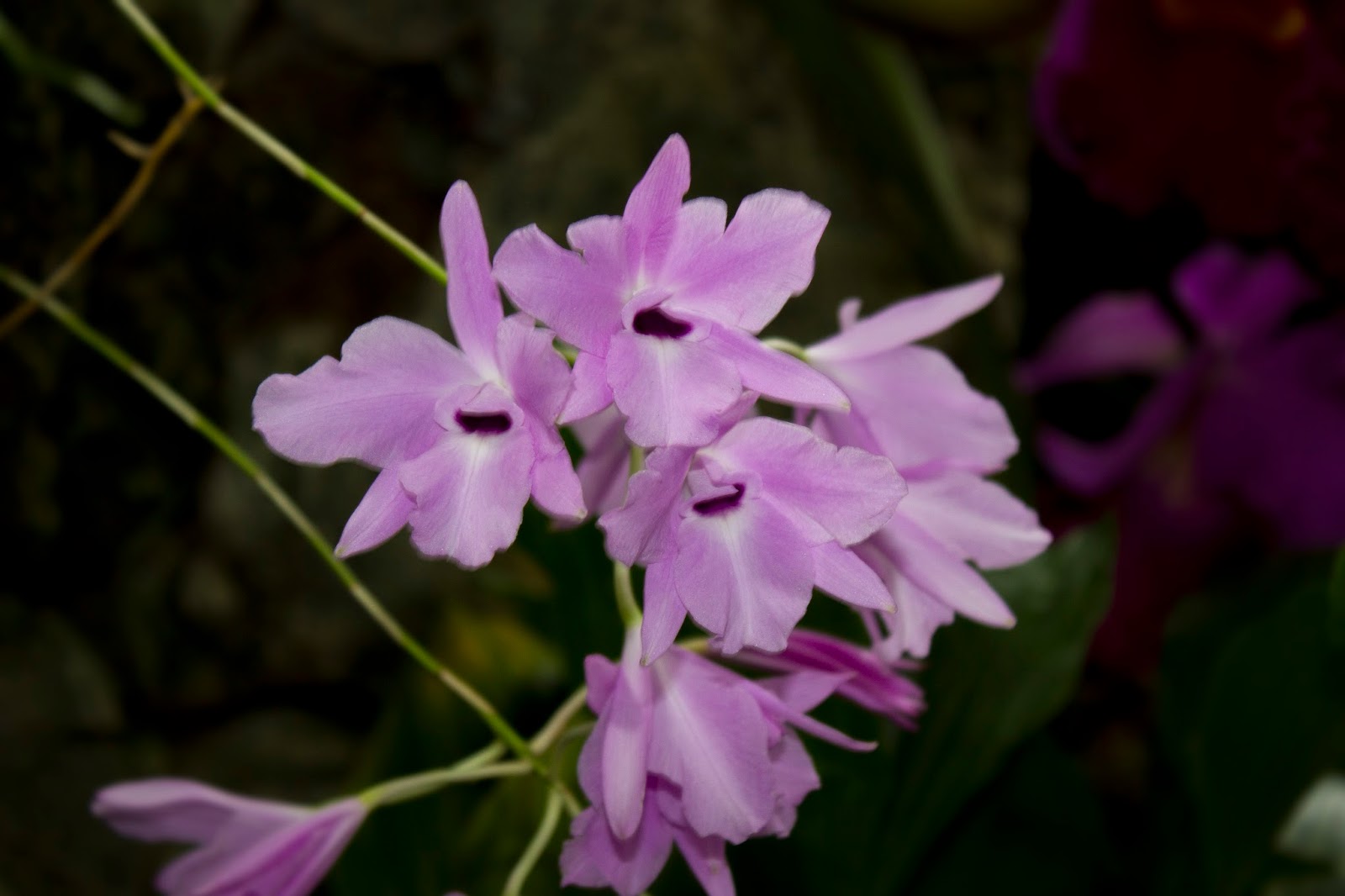
Dendrobium kingianum: the pink rock orchid

Dendrobium kingianum
Dendrobium kingianum is an Australian species popular among orchid growers. I love the delicate coloring of these flowers, and hybridizers must have too; Dendrobium kingianum has provided either the pollen or the seed to 158 registered crosses!

In its natural environment, Dendrobium kingianum usually grows in or around rocks (as a lithophyte), across much of eastern Australia, covering many habitats and weather patterns. I suspect that this variety of natural growth conditions is why Dendrobium kingianum is reputedly easy to grow in culture.
Closeup of Dendrobium kingianum flowers
Dendrobium kingianum flowers are about 1 inch across.  Lavender varieties like the one I photographed at the Bronx Botanical Garden are the most common.  However, flowers can range from white to deep purple. Australian Native Plants Society has some beautiful photos of purple and white varieties.

Dendrobium kingianum culture notes. (Massachusetts Orchid Society)

Saturday, September 24, 2016

What is a phalaenopsis? It might not be what you think

Phalaenopsis display at the 2016 New York Orchid Show

What is a Phalaenopsis?  If you are an orchid enthusiast, then at first this question might seem a little too simple.  After all, the Phalaenopsis is probably the most iconic orchid.  If you search google images for 'orchid', 7 out of the first 10 image results depict Phalaenopsis flowers. It's what I first think of when someone says 'orchid'.
What a Phalaenopsis orchid typically looks like: Phalaenopsis OX Black Face 'OX 1647'

What we typically refer to as a "Phalaenopsis orchid" are the myriad hybrids that belong to the Phalaenopsis genus. This classification encompasses approximately 60 species. Also known as the 'Moth orchid' or the 'Butterfly orchid' they are a colorful, varied, long-flowering and easy-to-grow plants that are a favorite among hobbyists and breeders alike. There are more than 35,000 Phalaenopsis hybrids listed in the International Orchid Registry, and nearly 100 new hybrids are added every month!

However, over time, I've come across orchid species that bear the name "phalaenopsis" which do not actually have much relation at all to the Moth Orchid.  

I wanted to find out, just how many such orchid species are named 'phalaenopsis'? Turns out there are Four. 

Bulbophyllum phalaenopsis
Caucaea phalaenopsis
Dendrobium phalaenopsis
Miltoniopsis phalaenopsis

This made me curious about what these orchids might have in common that they all earned the same species name?  Do they resemble the Moth orchid more than other species in their genus?  I decided to briefly profile each of these "Not phalaenopsis" phalaenopsis species and see what came up.

Bulbophyllum phalaenopsis
These flowers are weird. They look nothing like the Phalaenopsis genus, and app they smell like "dead, rotting mice".  Turns out this orchid was named not for its flowers, but rather for its large leaves. This species was discovered in 1937 in New Guinea.


Bulbophyllum phalaenopsis
Image credit: Image,  by Orchidgalore (Flickr gallery)
Bulbophylum phalaenopsis
Image credit: Image, Stefano (Flickr gallery)


Caucaea phalaenopsis (aka Oncidium phalaenopsis)
Before today, I've never even heard of an orchid genus called "Caucaea". These orchids are closely related to Oncidiums.  In fact Caucaea and Oncidium are so closely related, that "Oncidium phalaenopsis" is another name for the same species. Caucaea phalaenopsis grows at high elevations in Ecuador, where it was first described in 1869.
Caucaea phalaenopsis (aka Oncidium phalaenopsis)
Image credit: Image, by Dogtooth77 (Flickr gallery)
If I squint and ignore the typical oncidium flower shape, I can definitely see how the color pattern of these flowers evokes those of Phalaenopsis hybrids.

Dendrobium phalaenopsis
This is clearly another species that was named for its resemblance to common phalaenopsis hybrids. This species goes under a number of different names, including Dendrobium biggibum, Vappodes phalaenopsis, The Cooktown Orchid, and The Mauve Butterfly Orchid. This orchid is native to Queensland Australia, where it was discovered in 1852.
Dendrobium phalaenopsis
Image credit: Image, by Stefano (Flickr gallery)

Miltoniopsis phalaenopsis (aka Miltonia phalaenopsis)
This flower has almost the same color patterning as Caucaea phalaenopsis, and likely was similarly named for that reason. It was discovered in the cloud forests of Colombia in 1854.
Miltoniopsis phalaenopsis (aka Miltonia phalaenopsis)
Image credit: Image, by Quimbaya (Flickr gallery)
While none of these flowers are perfect doppelgangers of the Phalaenopsis genus, they clearly do have enough features in common to explain why they were named this way.