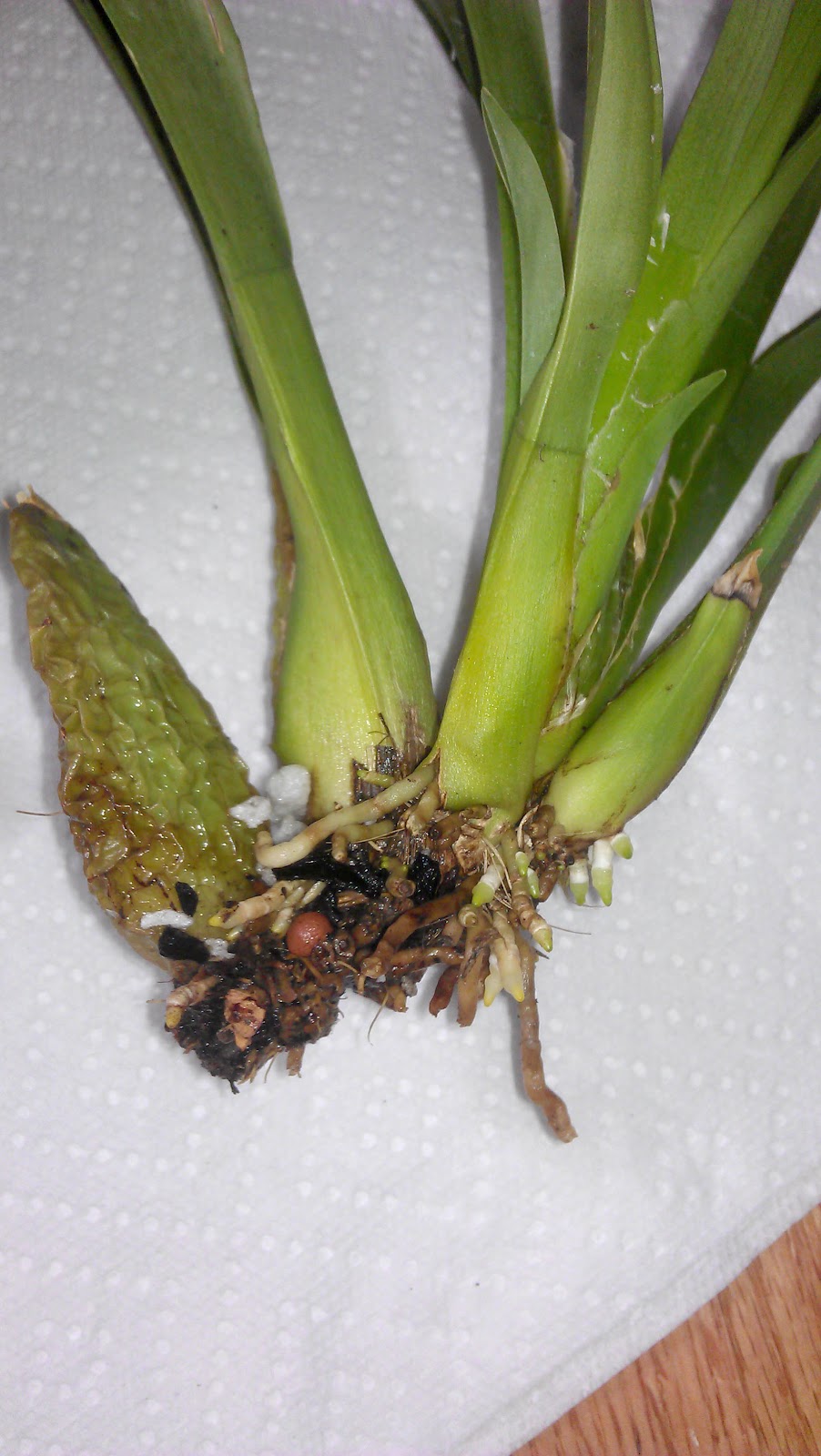
new growths on the left and right sides of the plant
My oncidium rescue has been slowly growing for the past few months, with two new growths on opposite sides of the plant. The one on the left picture is clearly visible, while the one on the right is mostly hidden within the folds of a larger leaf. Since I was in a repotting frame of mind after dealing with my den victoria-reginae's troubles, I decided to pop the incidium out of its pot to take a look at the root situation.
picture on right shows the very first pseudobulb: small and withered now
As you can see in the picture above, this orchid does not have much roots. Most of the rootlike stubble that you see is actually where I had trimmed back the dead roots months ago soon when I first bought the orchid. The only living roots are the 5 longish roots on the very left of the picture. These have been growing out from the newest big growth. I noticed that with oncidiums, roots seem to only grow from new parts of the plant. The old pseudobulbs seem to be entirely inactive.
Bringing the new roots into closeup, you can see 3 new root tips sprouting out. Although none of these roots are green, it is not atypical for roots growing without light. The new root tips make irrefutable proof that these roots are alive.
Meanwhile, further up on the same growth, 3 new roots are showing through. Since these roots sprouted above the level of the potting media, they are green colored.
oncidium in new pot, now closer to the lights
I had last repotted this oncidium in the fall. Although such frequent repotting is not ideal for orchids, I had several reasons to repot at this time anyway.
First, the media I had used last time was not the best for oncidium roots. I had used the typical coarse orchid mix that phals are often potted in. However, the rule of thumb is: the thinner the roots, the finer the media. Oncidium roots are much thinner than those of phalaenopsis. This time I used some "paph and phrag orchid mix" from repotme.com, which is better suited for thin orchid roots. Perhaps for future repottings I will purchase media specifically formulated for incidiums, but for now I saved money by using what I had at hand.
an ideal orchid pot would have lots of drainage holes
Second, I wanted to switch the orchid to a better pot. The previous container had only one drainage hole in the bottom, while the new one has 8. Better drainage will help the media dry out faster and prevent root rot.
Also, last time I had managed to pot the orchid at a crooked angle. Repotting allowed me to correct that. And finally, checking on the state of the roots lets me know if I am properly caring for the orchid and catch potential problems early. Meanwhile, since the orchid has so few roots, repotting is less likely to disrupt the orchids health. Unlike with overgrown orchids, this oncidium comes out of its pot easily, without breaking off delicate root tips.